Travel journal
A City Within the City
23 November 2011
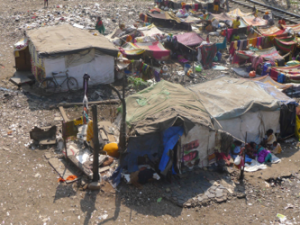 Some places are best understood by walking through them. Dharavi was one of those places, although our first lesson began on a train with the doors wide open.
We had heard from several people that a tour of Mumbai’s famous Dharavi neighbourhood was well worth taking. So, at nine in the morning, we met our guide at Churchgate station. He charged us 12 rupees each, bought our train tickets and led us on to a local train.
The doors never seemed to close. Silver bars and handles hung from the ceiling, ready for the crowds who usually filled the carriages. We were travelling after rush hour, so there was room to sit and take it all in. Twenty minutes later, we arrived at Dadar.
There, our small group crossed a railway bridge and entered a world that seemed to have its own rhythm. Around twenty people were weaving baskets, each working on their own, making the kind of baskets women carried on their heads.
Our guide explained that Dharavi covered an area roughly the size of 40 football pitches. He said about 1.6 million people lived and worked there. It was going to be a busy day.
He also asked us not to take photographs of people or their homes. Out of respect for the residents, the tour company would send us a few approved pictures later.
The ground beneath our feet had once been swamp. As our guide told it, people had dumped rubbish there instead of carrying it to a proper tip, until the swamp filled in. With land in Mumbai hard to find, people began building homes on top of it.
## The work behind the walls
Plastic arrived from across the city. Workers sorted it by colour and type, then crushed it so it could be made into new products. We were told the recycled plastic was used for things such as containers, though not for food because of the chemicals involved.
In another workshop, paper was shredded and turned into pulp. One worker fed the paper into a machine by hand. He wore a rubber glove, but his fingers seemed much too close to the grinding blades. I found myself watching his hand rather more closely than the machine.
Each narrow passage brought another stage of the work. Cloth was dyed. Paint tins were cleaned and prepared for reuse. Leather was made for export. Buffalo hides were stacked ready to be taken to Chennai for tanning. Our guide said the process was considered too toxic for Mumbai, though it continued elsewhere.
There was even a metalworking shop, with lathes making the machinery used by other workshops. The whole place seemed connected: one business made something another business needed, and materials that might have been thrown away elsewhere were put to work again.
The lathes were spinning, iron filings flew through the air, and the workers had no protective glasses or masks. Our guide explained that some workers felt safety gear slowed them down. A visitor had once provided protective clothing and glasses, only for the workers to put them through the recycling process and turn them into something else.
You had to admire the ingenuity, even while hoping they might reconsider the glasses.
One workshop was piled high with empty aluminium cooking-oil tins. A worker sat with an axe-like tool, heating it with a blowtorch, cooling its tip in water, then using it to seal holes and broken seams in the cans. We realised he was repairing the holes people punched in the tins to pour out the oil.
It was a wonderfully specific job. Somewhere in Mumbai, a person was fixing the holes everyone else made.
## A pastry with a secret
The lanes grew narrower as we walked. At times they were barely a metre wide, and we had to squeeze aside whenever workers needed to get past.
Our guide stopped at a small workshop and offered us a pastry. He explained that it was a local favourite, made there and sent across Mumbai, with some even packaged for sale abroad.
It was delicious. We thanked him and wandered a few steps further.
Inside, several young men were rolling out the pastry on the floor.
We decided not to ask for the recipe.
Nearby, children played with spinning tops in a clearing beside a river that flowed towards the bay. The river was choked with rubbish, and the smell made it clear why swimming nearby was not a good idea. On the bridge, trucks were tipping more rubbish straight into the water.
I had already decided against swimming at Chowpatty Beach. At that moment, I felt rather pleased with my judgement.
## Life in the lanes
Beyond the river, we entered the residential area. Our guide described how the neighbourhood had become divided between Hindu and Muslim streets after violent clashes in 1973. By the time we visited, we saw people from both communities sharing the streets, greeting one another and going about their day.
The lanes were full of small children, washing, conversations and the sound of people getting on with their work. We were shown the public toilets, which our guide said served around 1,500 people. Most homes were too small to have their own. In the mornings, he told us, the queues could stretch a long way.
A few steps away, children played beside piles of rubbish. Behind a wall stood government-built flats, their toilets out of reach of the people on the Dharavi side.
It was a sharp reminder of how close two very different worlds could sit beside one another.
Our guide said the oldest recorded home in the area was 171 years old. Yet this did not feel like a place frozen in the past. It felt busy, practical and full of purpose. People were washing clothes, making things, looking after children and calling out to neighbours.
We passed a workshop filled with expensive sewing machines, embroidering saris and other cloth on a large scale. A businessman had supplied the equipment and employed local people to make goods for sale elsewhere. The workers were paid little compared with the profits being made. The arrangement looked deeply unfair, even as the machines hummed steadily on.
Then we found the poppadom makers.
Women sat on the floor, rolling and cutting the dough before laying each poppadom on a bamboo tray to dry in the sun. Our guide said they earned about 25 rupees per kilo. A kilo could sell for around 120 rupees, and a woman might make three kilos in a day.
One of the women invited us into her home. It was a single, clean room, with a washing area and cooking stove at one end, a television at the other and a concrete floor where the family laid their mattresses at night.
She was proud to show us around. She was also very clear that we were not to stand on her clean floor.
Fair enough.
Our guide explained that people came to Dharavi for different reasons. Some residents had jobs elsewhere in Mumbai. Others found work in the neighbourhood. Many men in the workshops came from farming families in the countryside, spending seven or eight months at a time working, eating and sleeping near their workplace so they could send money home. He said they could earn far more than they would from farming, though it meant a hard and lonely life.
## Pots, classrooms and tea
A pottery district appeared around another corner. Thousands of pots stood drying in the sun. Men shaped the clay, kilns were fired with cotton rather than wood, and others painted the finished pots before setting them out to dry again.
We were told they could make around 400 pots a day, which were then sent elsewhere to be sold.
Our final stop was a nursery. The children sat on the floor while their teachers sang, trying to keep their attention. Then a group of tourists appeared, waving and saying hello.
The singing had very little chance.
Soon afterwards, we stepped out on to a busy main road, as if we had emerged from a different city. We visited a community centre run with support from Reality Tours, the company that had guided us. Young adults could take courses in English, computing and what they called soft skills: looking after yourself and taking pride in what you do. Each course lasted three months, with a small deposit returned when students completed it, making the courses free.
Back at the office, we had a cup of tea and filled in a questionnaire. Our guide explained that 80 per cent of the tour profits went towards community projects.
We left with a different picture of Dharavi from the one we had arrived with. There was poverty, pollution and work that could be dangerous or unfair. There was also skill, enterprise, care and a strong sense of community. People had built a working neighbourhood in a city where space was scarce, making use of what others discarded.
The tour did not make the hard parts disappear. It did make the people and the place harder to reduce to a label.
And, as I suspected, it confirmed that avoiding a swim in that river had been one of my better decisions.