Travel journal
The Medieval Mansion That Tried to Wake the Entire Village
1 August 2026
Some places welcome you with bright signs, automatic doors and a smiling receptionist.
La Maison des Échevins preferred psychological warfare.
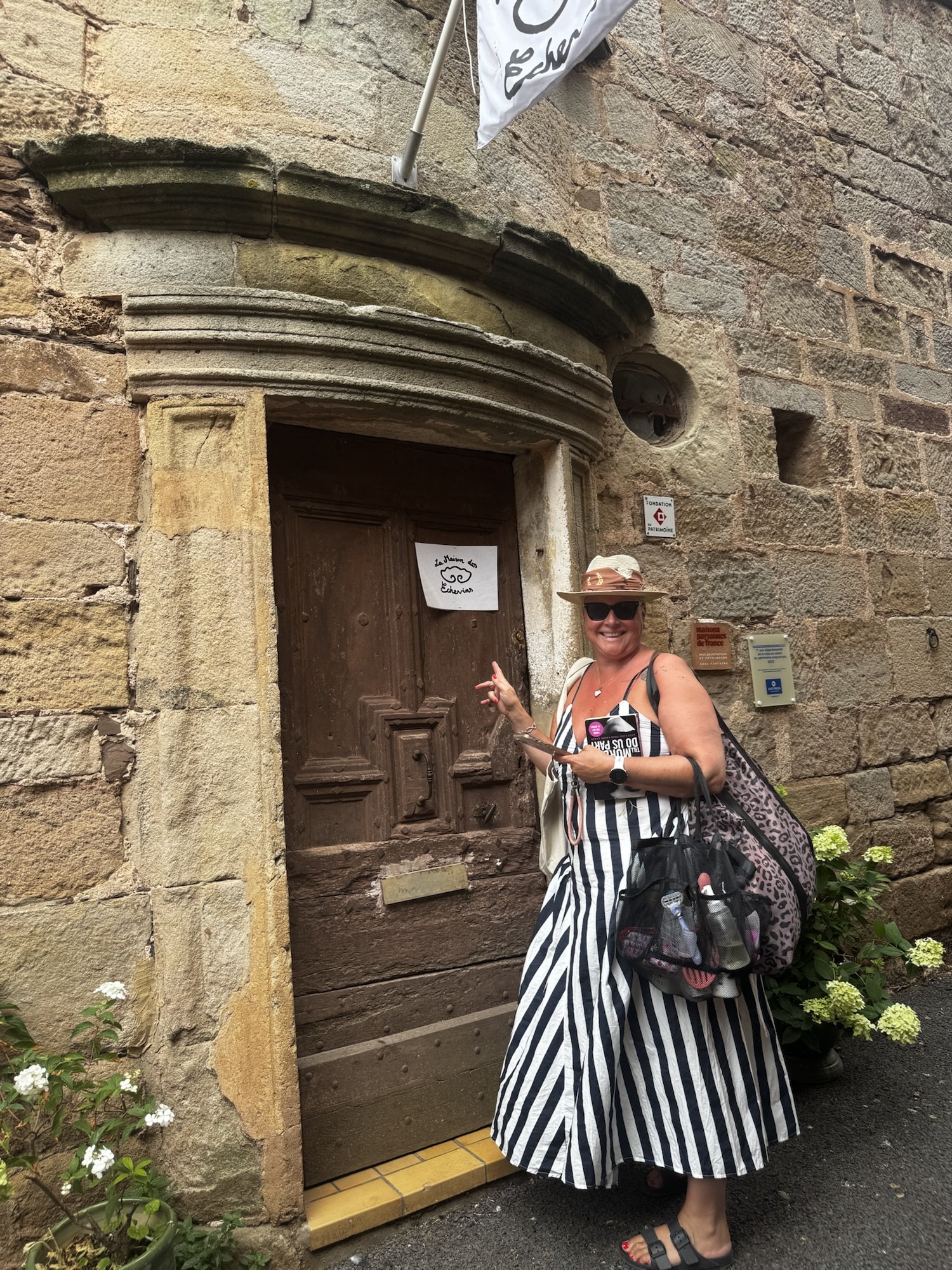
According to Google Maps we’d arrived.
According to our eyes, we’d parked outside a building abandoned sometime around the French Revolution.
The village of Vabres-l’Abbaye is tiny. Properly tiny. Blink while driving through and you’ll be checking into the next département instead. We’d chosen it because it was close to the Roquefort cheese caves, and after several hours on the road we were looking forward to somewhere comfortable.
Instead, we found ourselves staring at a giant weathered wooden door that looked as though it hadn’t been opened since Napoleon popped round for tea.
Every shutter along the narrow street was tightly closed.
There wasn’t another soul in sight.
No reception.
No sign saying “Welcome.”
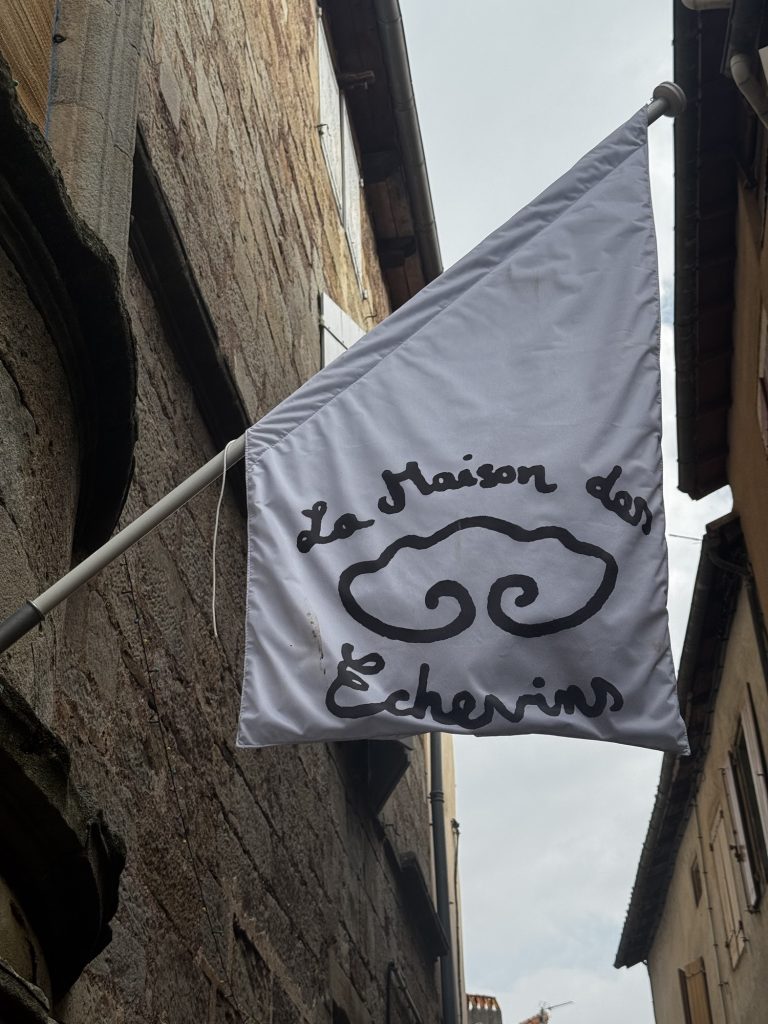
Just a white flag fluttering above the doorway with La Maison des Échevins painted across it.
Dana looked at me.
“Are you sure?”
“Absolutely.”
“You’ve said that before.”
“I mean it this time.”
The trouble is I’d also confidently led us down several dead ends that week, so my success rate wasn’t exactly encouraging.
For a few moments we genuinely wondered whether we’d booked a museum.
Or possibly a haunted house.
Then the door opened.
Within seconds the whole place transformed.
It wasn’t old.
It was magnificent.
Stepping inside felt like accidentally walking into a French stately home where someone had simply forgotten to rope anything off.
The spiral stone staircase twisted upwards through the middle of the house, every step worn smooth by centuries of feet.
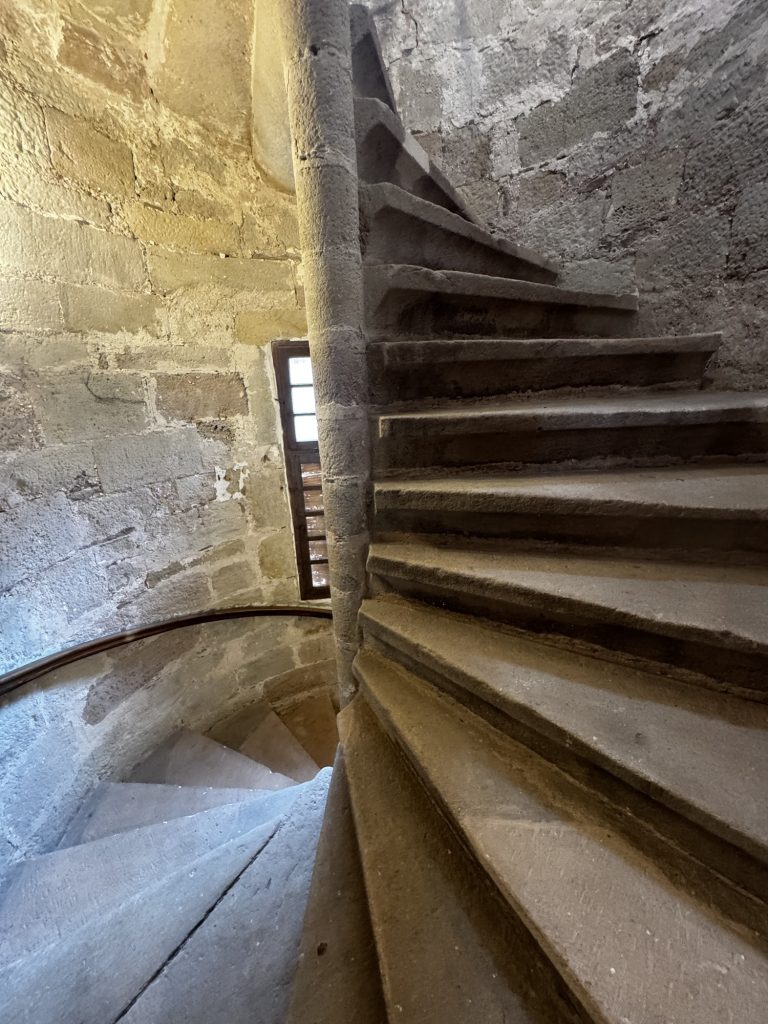
I couldn’t stop wondering how many people had climbed those stairs before us.
Medieval merchants?
Local officials?
French nobles?
Someone delivering Amazon parcels?
The staircase had certainly seen more history than my passport.
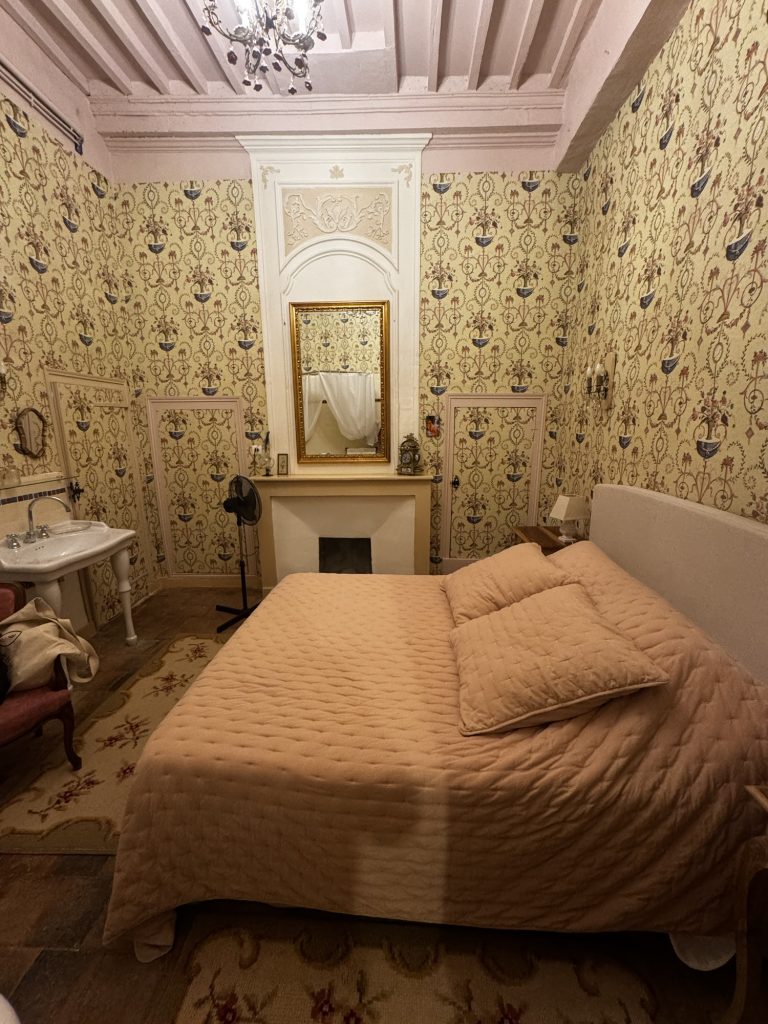
Then we opened the bedroom door.
Actually, calling it a bedroom feels unfair.
It was more of a small cathedral with a bed in it.
The ceilings were so high I briefly wondered whether hot air balloons were permitted indoors.
Massive timber beams stretched overhead while elegant wallpaper covered walls that had probably stood there before England had figured out what plumbing was.
The centrepiece wasn’t the bed.
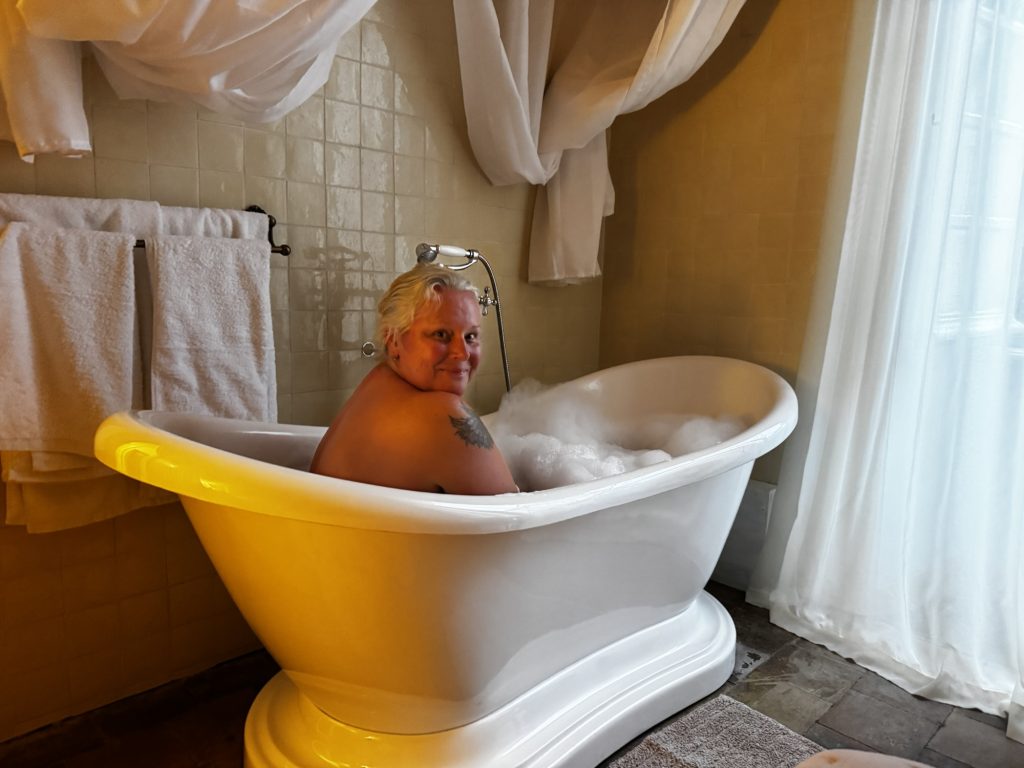
It was the enormous freestanding bath sitting proudly beside it.
Not in the bathroom.
Beside the bed.
Hidden only by flowing white curtains that looked like they’d been borrowed from a Shakespeare production.
Nothing says romance quite like asking,
“Are you having a bath, or should I make a coffee?”
Even the wash basin stood proudly in the corner of the room without the slightest concern for privacy.
The whole place ignored modern hotel design completely.
Thank goodness.
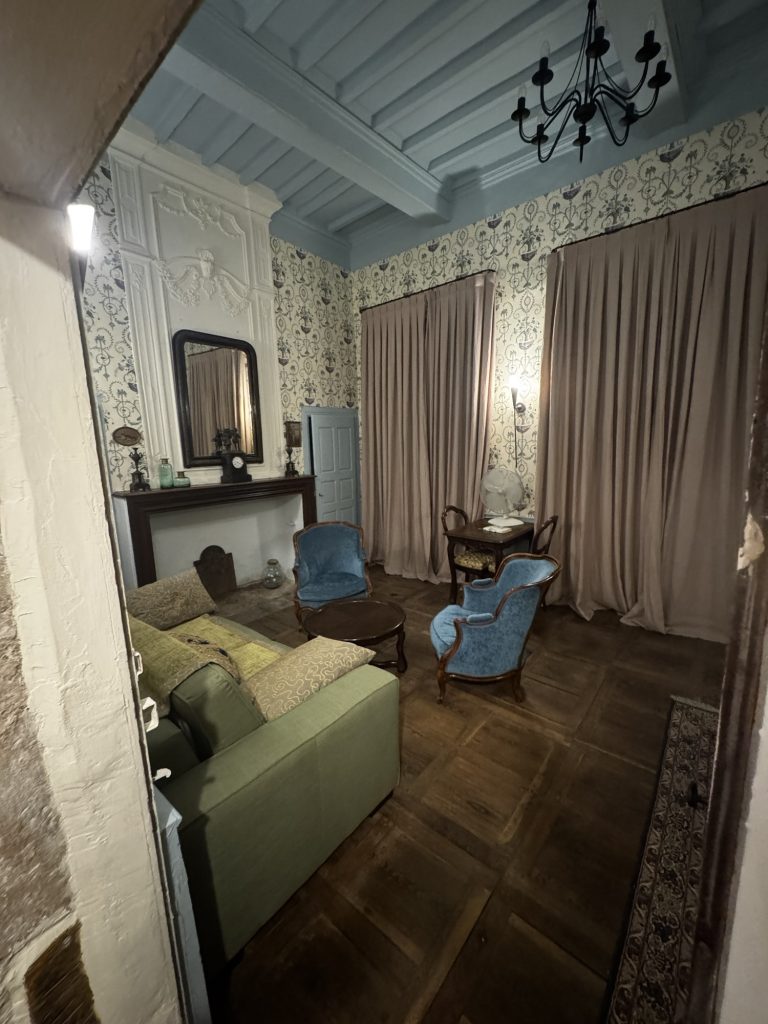
Next door was our sitting room.
Not a sitting room.
Our sitting room.
With antique chairs, polished wooden floors, a grand fireplace and windows overlooking the sleepy lane below.
It felt as though someone had handed us the keys to a French manor house and forgotten to mention the staff had all gone home sometime in 1824.
Then we discovered the kitchen.
Or more accurately…
The wardrobe.
One cupboard door opened to reveal what looked perfectly ordinary.
The next revealed a microwave, sink, kettle, coffee machine and fridge squeezed into a space barely bigger than an airing cupboard.
French engineering at its finest.
“I reckon they’ve broken several laws of physics fitting all that in there,” I said.
Dana simply made coffee.
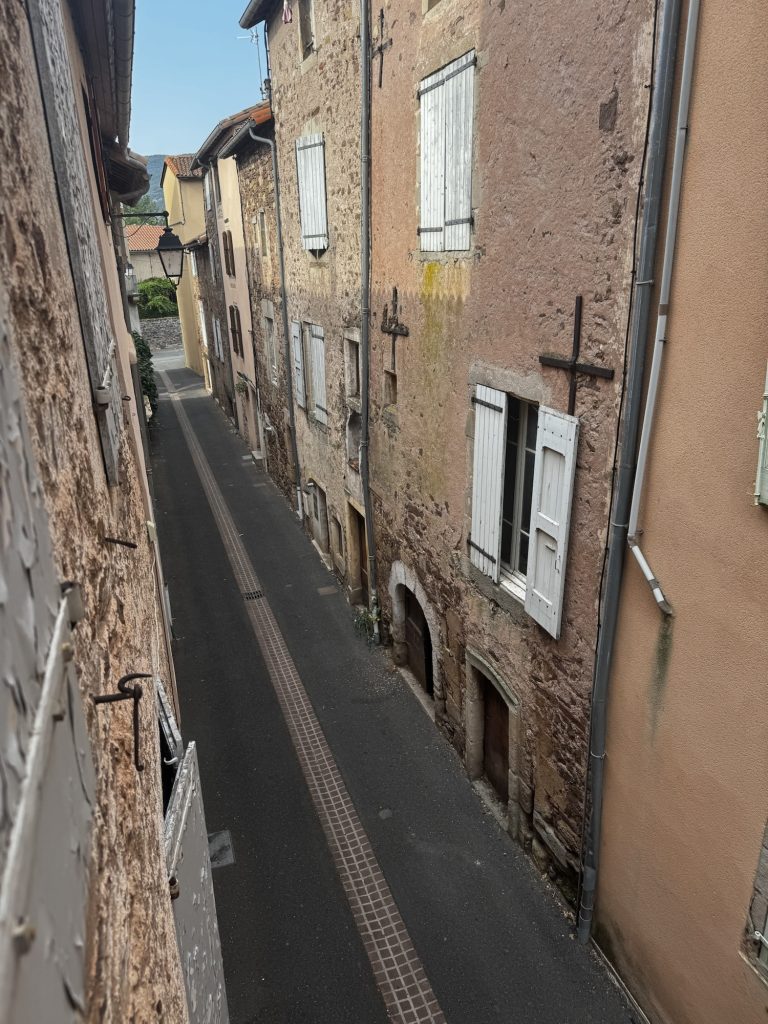
Looking out of the upstairs window was like staring into another century.
Tiny stone cottages.
Crooked shutters.
Ancient wooden doors.
Not a single modern shop sign.
Not even a passing car.
The only thing missing was someone wandering past with a horse and cart.
Then six o’clock arrived.
Dong… Dong… Dong…
The church bell rang.
Then… silence.
About five minutes later…
Dong… Dong… Dong…
The exact same church started all over again.
We looked at each other.
“Didn’t it just do that?”
Apparently this wasn’t a fault.
It was entirely intentional.
The bell rings a few minutes before the hour as a warning, just in case you’re busy doing something terribly important, like eating cheese or having a nap. Then, when the actual hour arrives, it politely reminds you again.
Every.
Single.
Hour.
By ten o’clock I found myself checking my watch after the first set of bells.
“Right… that’ll be ten in about five minutes.”
Sure enough…
Dong… Dong… Dong…
It was like having a church-operated snooze button.
By eleven o’clock the final chimes drifted across the rooftops and the village finally settled into silence.
We smiled.
“That’s bedtime.”
It was.
Until seven the following morning.
Without warning, the bell launched into what can only be described as its greatest hits album.
Not a few gentle chimes.
Not a polite reminder.
It rang continuously, pealing out across the valley for what felt like an eternity, enthusiastically informing every man, woman, child, dog and pigeon that a new day had begun.
There wasn’t the slightest possibility of sleeping through it.
To be fair, nobody in Vabres-l’Abbaye has probably ever been late for work.
The church simply won’t allow it.
Oddly enough, despite being serenaded by half the ecclesiastical community of southern France, we slept remarkably well.
There was no television.
No radio.
No air conditioning humming.
No traffic.
Just thick stone walls, cool night air and the sort of silence you only find in villages where almost everyone has gone to bed before the news finishes.
Even the toilet had character.
A tiny little window looked onto the lane below, where the old orange streetlight filled the room with a soft glow that somehow made even a midnight visit feel oddly atmospheric.
I never imagined I’d become sentimental about a toilet.
Yet here we are.
The following morning we wandered downstairs to breakfast, where our hostess greeted us with the enthusiasm of someone genuinely proud of everything she was about to place on the table.
“So,” she smiled, “I’m going to tell you what you’re going to eat.”
It wasn’t a menu.
It was the story behind the breakfast.
She pointed to a small jar.
“This is kiwi jam. The kiwis came from our garden. We used to have lots, but now only a few.”
Then another.
“And this is plum jam. Also from the garden.”
Next came a generous wedge of creamy sheep’s cheese.
“This is local sheep’s cheese. Very good.”
She smiled as if there was only one acceptable response.
There was.
Beside it sat slices of dry local sausage, fresh bread, flaky croissants and butter.
“You can eat the skin… or take it off,” she explained, carefully demonstrating with her hands.
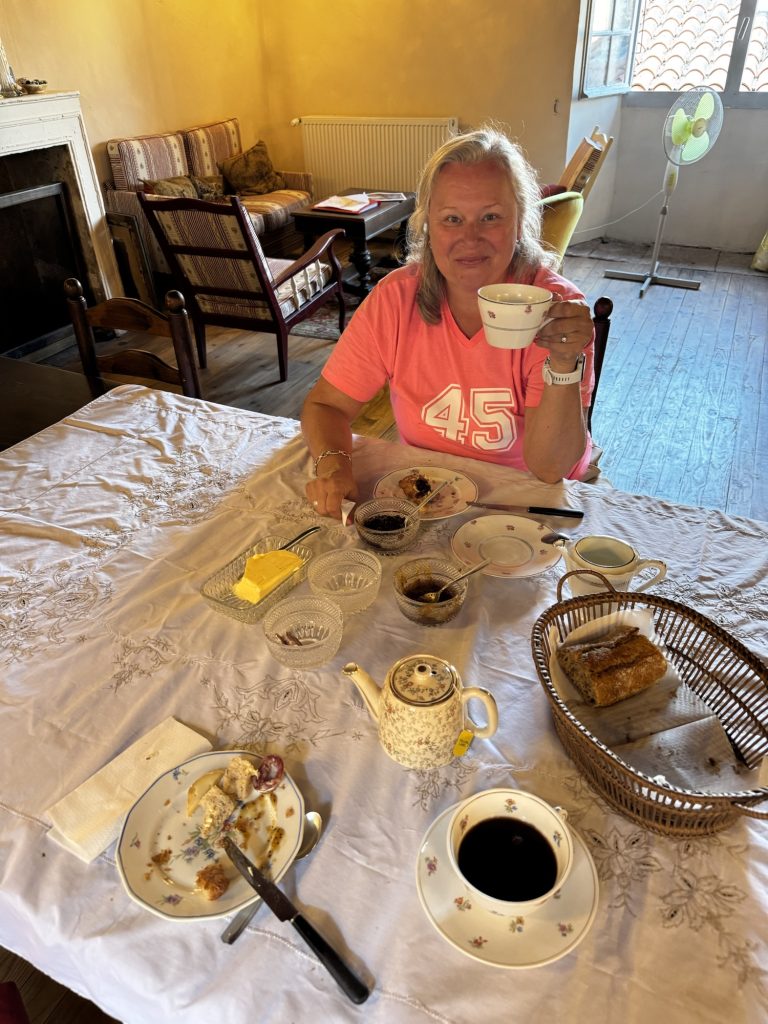
While she made our tea, she noticed us discussing our plans.
“You’re going to Roquefort today?”
“We are.”
“You must!” she laughed. “And try a nice Roquefort.”
She lifted the cheese already sitting on our table.
“This one comes from Papillon - Butterfly. It’s one of the Roquefort producers.”
Then she pointed to the shape of the cheese.
“It’s called a log because…” she paused, searching for the English word before smiling, “…it looks like a log.”
Dana and I looked at each other.
“We like cheese,” I replied, probably a little too enthusiastically.
“I can tell,” she laughed.
It was one of those breakfasts that couldn’t be recreated in a hotel. Nothing was rushed. Nothing came from a buffet. Every jar, every slice of cheese and every recommendation came with a story.
By the time we’d finished our croissants and drained the last of the coffee, we weren’t just looking forward to visiting the Roquefort caves.
We already felt as though we’d been given a little introduction to them by someone who genuinely loved the region.
As we were finishing breakfast, our hostess smiled.
“If you like,” she said, “you can go up and see the pigeon loft.”
Then she simply pointed towards the staircase.
No guided tour.
No safety briefing.
No disclaimer asking whether we’d ever climbed medieval stairs before.
Just complete trust.
We happily accepted the challenge.
Back up the ancient spiral staircase we went, climbing higher than we’d ventured the night before.
The stone steps became narrower.
The ceiling became lower.
The walls thicker.
Eventually we reached a tiny doorway that looked as though it had been designed for people several inches shorter than us.
“Duck,” Dana reminded me.
“I know.”
I didn’t know.
My forehead briefly became acquainted with fifteenth-century stonework.
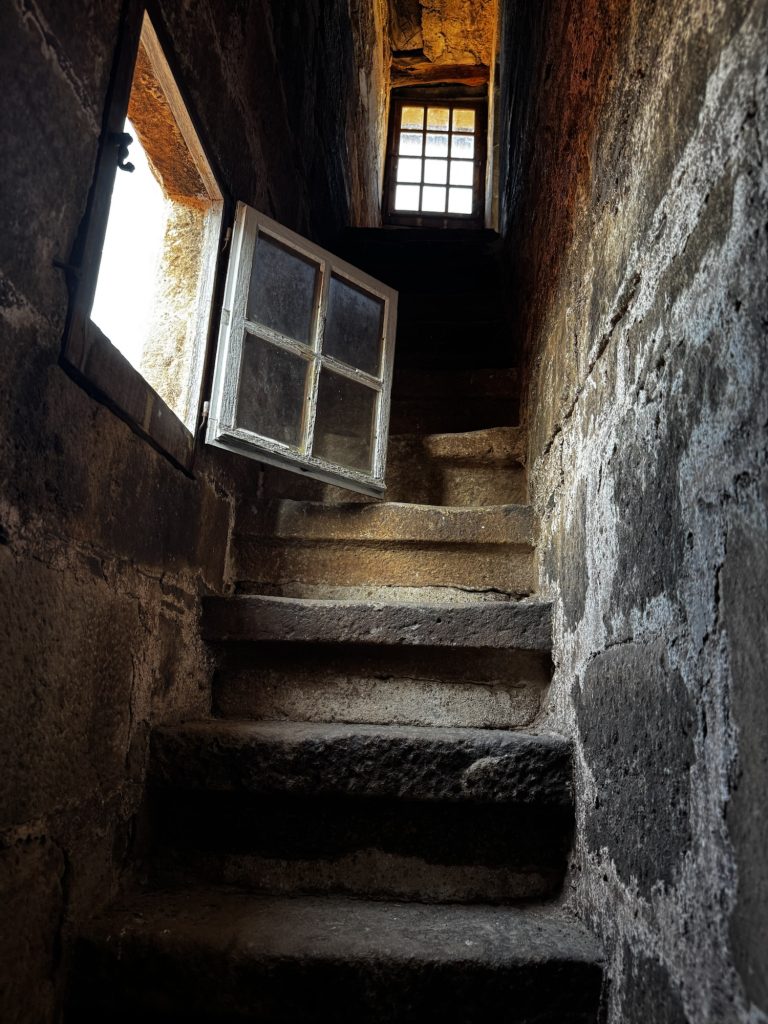
The final flight of stairs was unbelievably narrow. Dana squeezed up with surprising elegance, while I followed behind wondering how medieval people managed carrying anything larger than a loaf of bread.
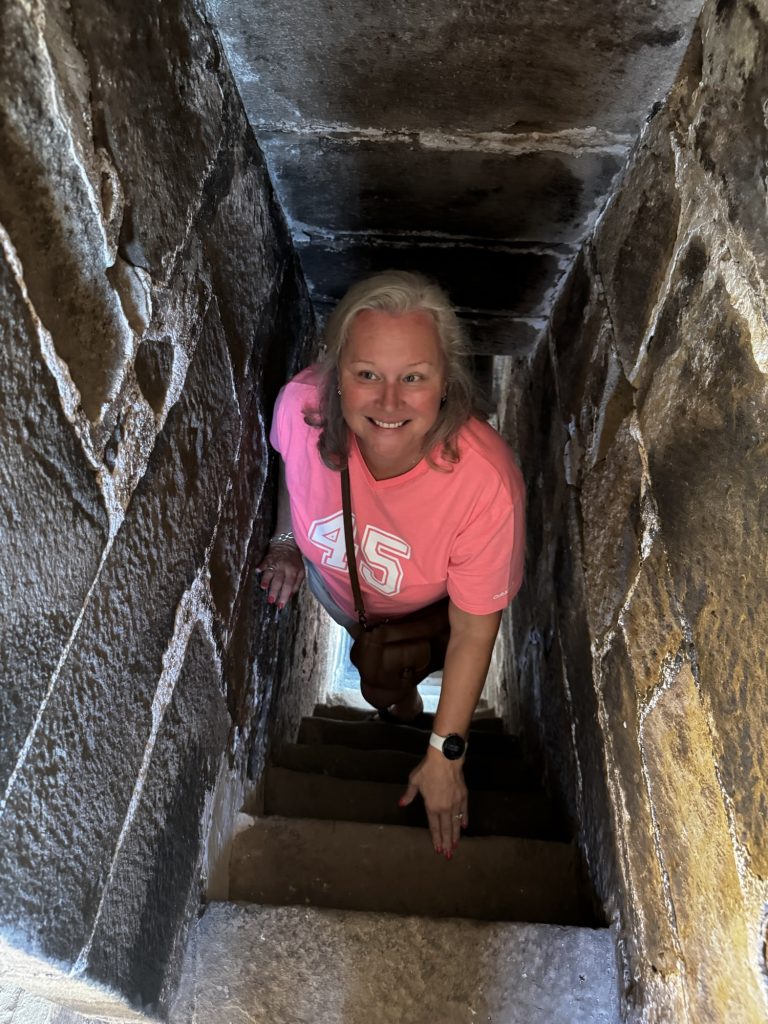
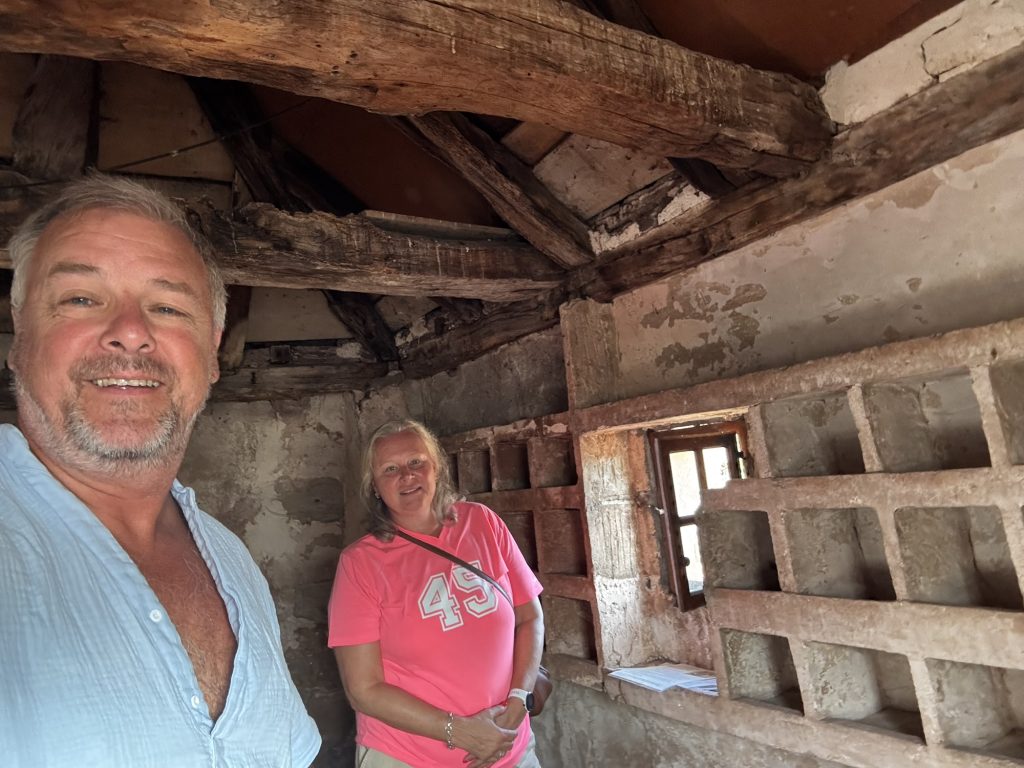
At the top we emerged into the old pigeon loft.
It was one of those hidden spaces you would never discover unless someone invited you to explore. Thick oak beams stretched across the roof, while hundreds of little stone nesting holes lined the walls where pigeons had once lived. In medieval France, owning a dovecote like this was a symbol of wealth and status. The pigeons weren’t simply decorative - they provided meat, eggs and valuable fertiliser for the surrounding land.
Standing there, it felt like we’d wandered into a forgotten corner of history.
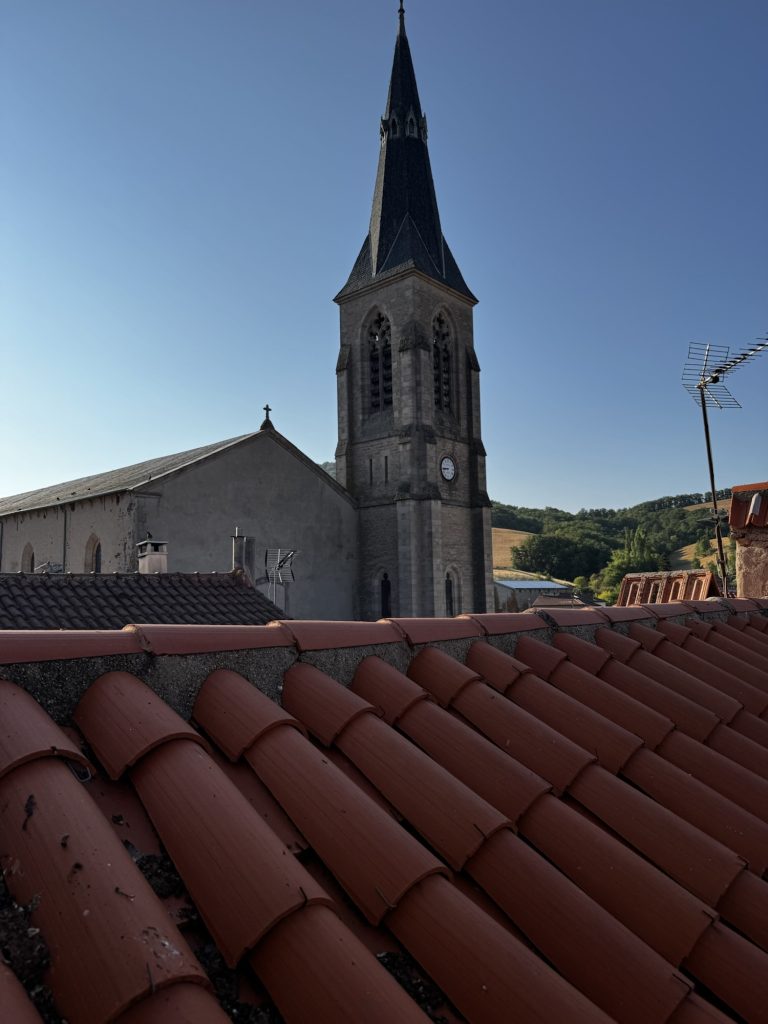
The tiny windows framed spectacular views across the rooftops of Vabres-l’Abbaye. Beyond the terracotta tiles stood the village church, its elegant spire reaching into the blue morning sky. Our hostess had told us it was once part of a Benedictine monastery, and from up here it was easy to imagine monks looking out over exactly the same rooftops centuries earlier.
The morning sun bathed the valley in warm light, and for a few peaceful minutes there wasn’t another person in sight.
Then…
Dong.
The church bell rang.
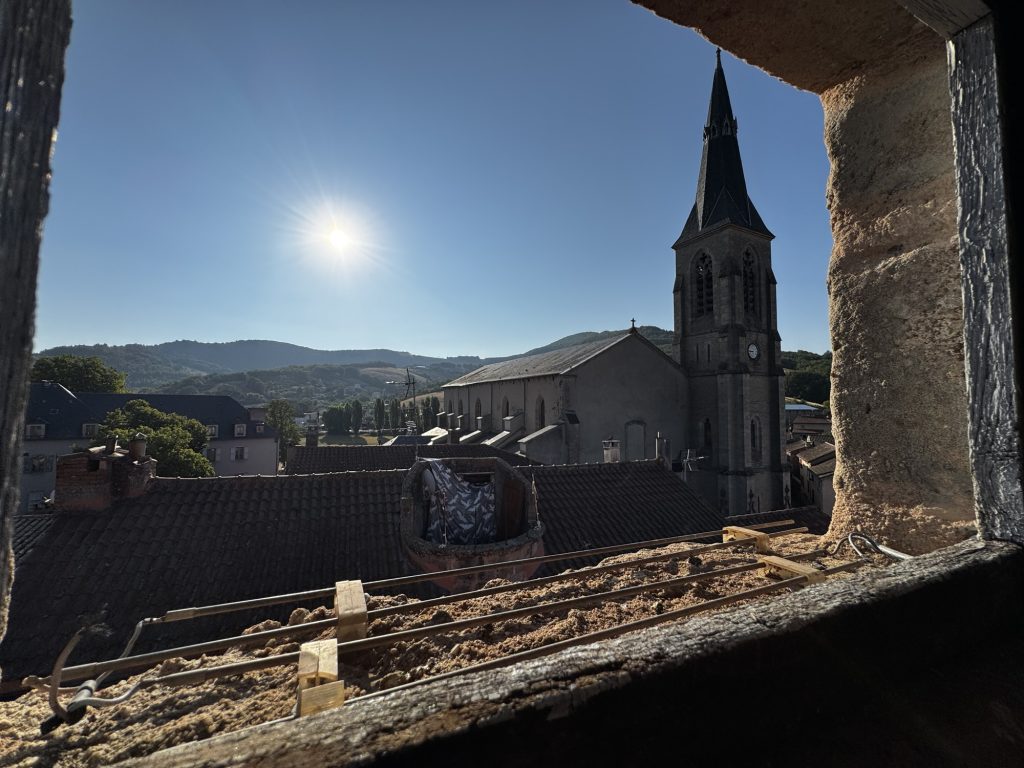
Followed a few moments later by another.
I looked at Dana.
“I think they’ve spotted us.”
Even hiding in a medieval pigeon loft wasn’t enough to escape Vabres-l’Abbaye’s enthusiastic commitment to telling the time.
We’ve stayed in expensive hotels with swimming pools, rooftop bars and enough cushions to build a small fort.
Yet months from now, I probably won’t remember many of them.
I’ll remember arriving outside a giant wooden door wondering whether we’d booked the wrong place.
I’ll remember climbing medieval stairs carrying a suitcase with wheels completely unsuited to the fourteenth century.
I’ll remember a bath sitting proudly beside the bed.
And I’ll definitely remember the church bells.
Every single one of them.
They weren’t just keeping time.
They were making absolutely certain the rest of the village knew what time it was too.