Travel archive
Chan Chan
23 January 2016
Every time we take the bus to and from Trujillo (the large town half an hour away - where we go for the groceries we can't get in Huanchaco such as cereals) we have to pass Chan Chan.
A quick google search tells us it is a very important site.
Here is what Wiki has to say about it:
The largest Pre-Colombian city in South America, Chan Chan is an archaeological site in the northern Peruvian region of La Libertad, 5 km west of Trujillo. Chan Chan is located in the mouth of the Moche Valley and was the capital of the historical Chimor Empire from AD 900-1470 until they were defeated and incorporated into the Inka empire.  The Chimor empire, a conquest state, developed from the Chimu culture which established itself along the Peruvian coast around 1400 AD. In the Chimú tongue, Chan Chan means "Sun Sun;" it was named for its sunny climate which is cooled year round by a southerly breeze.
Chan Chan is believed to have been constructed around 850 AD by the Chimu. It was the Chimor empire capital city with an estimated population of 40,000-60,000 people.
After the Inca conquered the Chimú around 1470 AD, Chan Chan fell into decline. In 1535 the Spanish city of Trujillo was founded which pushed Chan Chan further into the shadows. While no longer a teeming capital city, Chan Chan was still well known for its great riches and was consequently looted by the Spaniards. An indication of the great Chimú wealth is seen in a sixteenth century list of items looted from a burial tomb in Chan Chan; a treasure equivalent to 80,000 pesos of gold was recovered (nearly $5,000 US dollars in gold).
 The city of Chan Chan spanned 20 km² and had a dense urban center of 6 km² which contained extravagant ciudadelas. Ciudadelas were large architectural masterpieces which housed plazas, storerooms, and burial platforms for the royals.The splendour of these ciudadelas suggests their association with the royal class. Housing for the lower classes of Chan Chan's hierarchical society are known as small, irregular agglutinated rooms (SIARs). Because the lower classes were often artisans whose role in the empire was to produce crafts, many of these SIARs were used as workshops.
In 1969, Michael Moseley and Carol J. Mackey began excavations of Chan Chan; today these excavations continue under the Peruvian Instituto Nacional de Cultura.
So it's about 500 years older than Machu Picchu so in our book - it's definitely worth a look whilst we are here.
The bus to get here was only about 20p each and the bus stop feels like it is in the middle of the desert.
 Once we'd got off the bus we had a 2km walk along the dusty road to get to the entrance. As we walked, the walls got nearer and nearer and we could really see just how big it was. It was enormous.
So much of this place lies just how it has for centuries but part of it has been reconstructed to show what it would have been like and it's those parts that were imposing down on us now as we walked.
It was incredibly hot and as we walked, we could see the vultures along the top of the wall just waiting for us to drop so they could pick our bones.
OK so thats a bit dramatic we know but when we got to the ticket hut, large bamboo had been planted to give some welcome shade and we plopped down under it for a while.
The ticket was really cheap - £2 or 10 soles. So we decided we liked the look of the friendly guide and for £8 he would tell us all about Chan Chan.
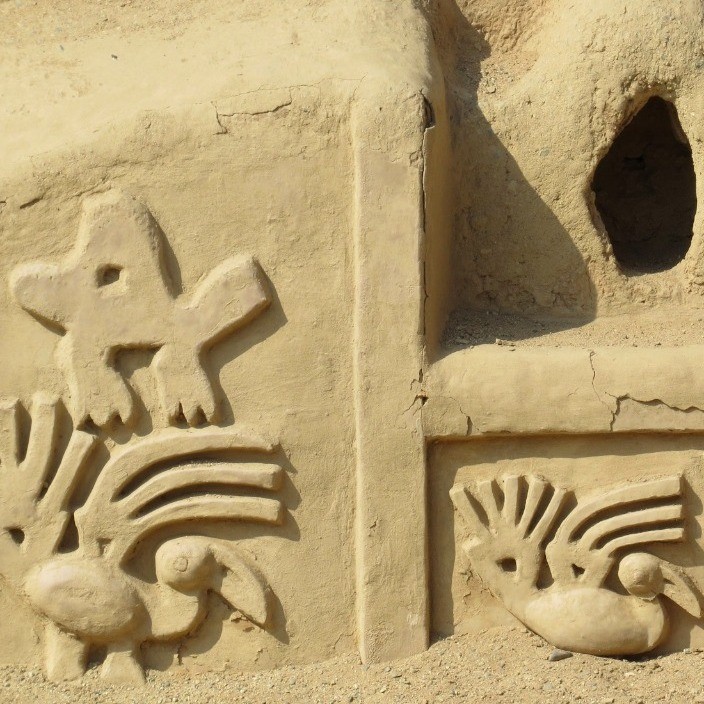
 As we wandered around the Ciudadela, we could see lots of reconstructed areas. The walls had mud relief work on them giving the walls glamourous patterns along the bottom. We asked how the reconstruction workers could know to put those patterns on as it seemed as if it must be guess work. However, that is not the case. He explained that when they started brushing away the mud that had piled up against the bottom of the walls where the wind and rain had blown it off the top over the centuries, they uncovered some perfectly preserved embellishments which they have painstakingly recreated over the rest of the walls.
Wow! Incredible to think that mud has survived like that for 500 years at least.
He also explained that the area of Chan Chan is vast - about 20 km sq but they only had funding to reconstruct a very small part of it. Hence they chose the Ciudadela as it had so many uses and much history. Later as we left the Ciudadela, we could see and understand just how many other structures we were looking at. Ruined walls lay everywhere and we wondered what other secrets lay buried there.
 Our guide was a very nice man and the tour was only supposed to take an hour, but he was so chatty and friendly that it was almost 2 hours later when we rolled out of the entrance again. We bought the 3 of us an icecream and as it was now clocking off time for him, he offered to give us a lift up the road. We didn't need asking twice. We didn't fancy the 2km walk back up the road in the heat to the bus stop so drop us off he did, along with the ticket man and another guide.
What a friendly helpful lot these Peruvians are.
Another reason why we like it here!

road to Chan Chan

inside the Ciudadela

Turkey Vulture

mud wallpaper

our lovely guide