Travel archive
About Tibet
21 August 2011
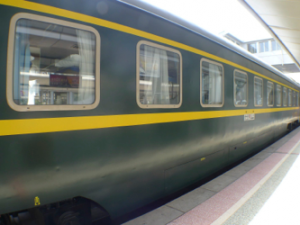 The train was due to depart at 20:58 from the North Station in Chengdu. With previous stations in China, which up until now had been so busy people would be pushing and shoving just to get in to the train station, we decided and was advised to arrive at the station at least two hours before the train departed.
Arriving early at the station we found the station quite bearable and easy going. We sat outside gate one and two waiting for our train. Noticing that not many whities were in the seats waiting for the train, in fact we only spotted one family who as it turned out where from America and on holiday in China. Everyone else appeared to be Chinese.
Boarding the train we were one of the first people on, just amazing as some 800 people seem to be waiting for the train. True to form the cabin was full. As we had booked a hard sleeper, which is six beds to a room and no door, we were expecting it to be a noisy night. We were sharing with two Chinese girls who were lovely and very polite and quiet, and two Chinese men, one of whom was noisy and later we would find would snore loudly, snort and spit. Many if not all of the men are rude and very noisy, snorting and smoking even though the signs say no. You can quietly ask them to be quite or not to smoke and they will respect your request. But still why do they do it in the first place?
A little history behind Tibet before we enter the region.
Just at the turn of the 20th century Lord Kitchener, the then Commandeering-in-Chief of the British army ordered to set up a trade route through Tibet. This would be the first time that such negotiation would take place in Tibet. After much fighting and many losses of life the British army defeated the local Tibetans and soon afterwards a treaty was signed. The invasion of the British in 1904 is classed by the Tibetans as a betrayal of their innocence.
This treaty lasted almost 50 years before China until a resurgent China invaded Tibet, claiming it was 'liberating' the people from feudal serfdom and bringing it back to the motherland's fold.
Tibet is a high altitude desert plateau at more than 4,000m with many places reaching over 5,000m, so if altitude sickness is going to occur then this is where it is going to happen
We went through some spectacular scenery with the highest point reaching 5,072m at Tanggula Pass and with about 80% of the Golmud to Lhasa stretch being over 4,000m, this makes this the world's highest railway and by default - one of the most spectacular.
Due to the heights the train travels, extra oxygen is pumped into compartments between Golmud and Lhasa. The trains otherwise are not much better equipped than normal trains in China, but the schedule is designed so at to let you enjoy the best scenery during daylight hours. It ambles along at a leisurely pace - not like the 300km/hr trains they have just introduced!
Our seven day trip, with our guide of course, will take in the magnificent and justifiably world famous Potala Palace which contains over a thousand rooms and raises to 13 stories. Something you can't really miss when in Lhasa.
The spiritual centre of Tibet with waves of pilgrims at Jokhang Temple is also on the itinerary. Outside of Lhasa about 5km north we have a planned trip to Sera Monastery. With about 500 monks still in residence, in it's hay day some 5,000 monks would have originally have populated the monastery. A run out to Yamdrok-Tso lake which has a fabulous shade of deep turquoise with Mt Nojin Kangstang in the distance reaching 7,191m. The town of Gyantse should give us a very true picture of Tibetan life. Finally when en-route to The friendship bridge with Nepal we'll be visiting Everest Base Camp at a height of 5,150m. With a clear view up a glacial valley to the star North Peak making it the best place to see Everest. lets hope for a bright clear day to get some amazing photographs.
Our Tibet trip ends when we are dropped off at the friendship bridge which is at the Nepal border and then we are Off On Our Own again and have to make our own way in Nepal which we planned to have 30 days to explore next month.