Travel journal
Harriet Goes to Work
26 August 2026
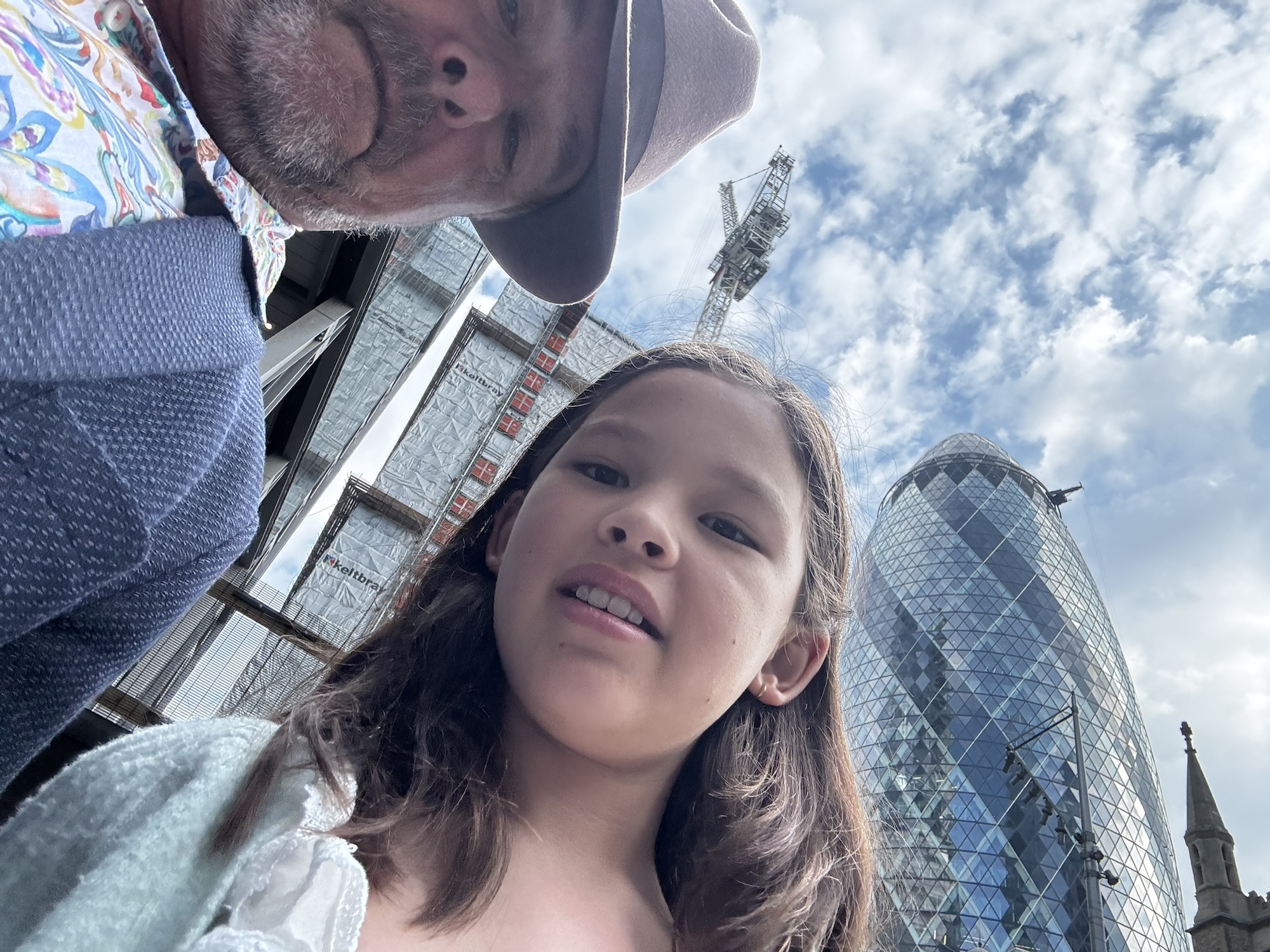
Paddington, AI Fish and the Jelly Baby Skyscraper
What happens when you take a ten-year-old into a London office for the day and tell her she is going to learn about artificial intelligence, smart cities and the future of work?
She eats the building materials.
Well, Grandad Bryan does.
Wednesday started at 5.45am, which was a particularly painful time of the morning considering Harriet had only recently rediscovered the existence of mornings before ten o’clock.
There was a good reason, though. We were catching the 7.35am train to London, and Harriet was coming to work with Grandad Bryan for the day.
This meant dressing appropriately.
Grandad Bryan appeared in a jacket, a wildly colourful shirt and his hat, looking somewhere between a City consultant and a detective investigating the mysterious disappearance of somebody’s inheritance.
Harriet was carrying a proper brown leather briefcase.
She looked far more professional.
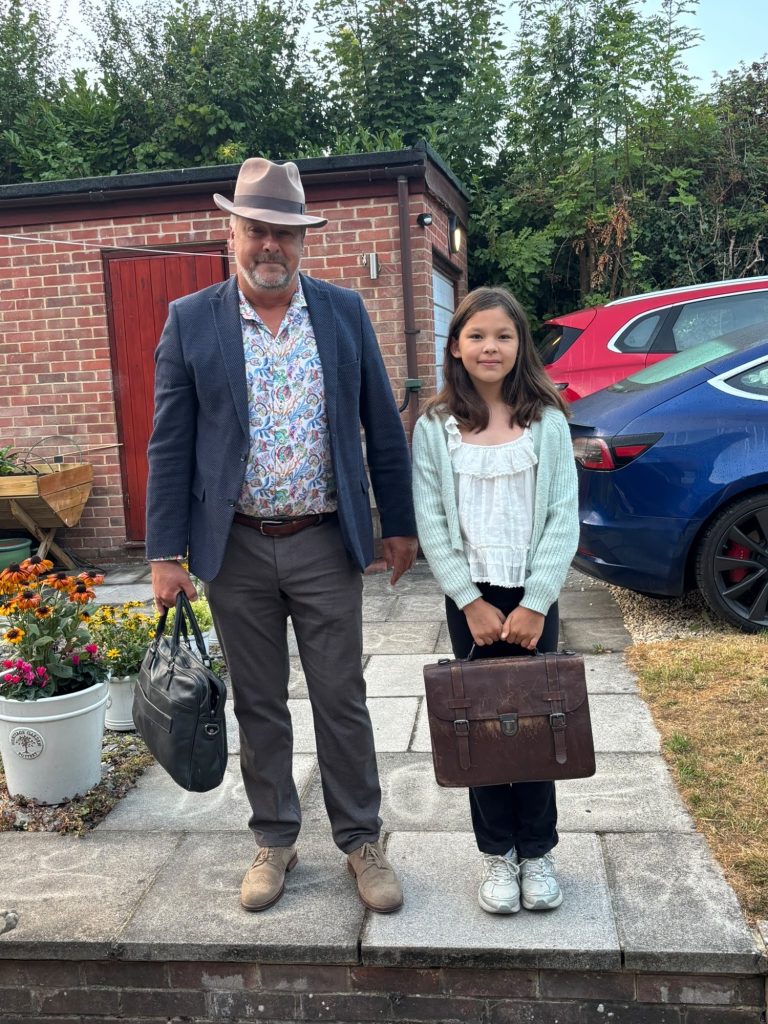
We drove through the quiet Wiltshire morning to Hungerford station.
Grandad Bryan had done something extraordinary.
He had arrived early.
Not just early enough to avoid running, but nearly half an hour early.
Grandad Bryan explained to Harriet that this was not his usual railway technique. Normally, he arrived just as the train was coming into the station, realised he was on the wrong side, ran over the footbridge, came down the other side at speed and jumped aboard panting heavily.
Today there would be none of that.
Harriet probably thought Grandad Bryan was exaggerating.
He wasn’t.
Outside the station was a little coffee van, where a very friendly young woman was serving the early commuters.
Grandad Bryan ordered a latte.
“Three pounds,” she told him.
Grandad Bryan looked at her as though she had made a serious financial error.
“You’re far too cheap.”
It probably wasn’t the response she normally received from customers.
She explained that she worried her local regulars would complain if she increased her prices.
Grandad Bryan immediately began discussing her business model with her, because apparently it is impossible for him to buy a coffee without providing free consultancy.
Harriet, meanwhile, had a far more important decision to make.
Eventually she chose a Sprite.
Grandad Bryan looked at his warm latte.
Then at Harriet’s ice-cold fizzy drink.
It was a cool, fresh morning and we still had half an hour standing on a railway platform.
“You’re having a cold drink?”
“Yes.”
Fair enough.
At the ticket machine, Harriet helped work out the tickets before we wandered onto the platform.
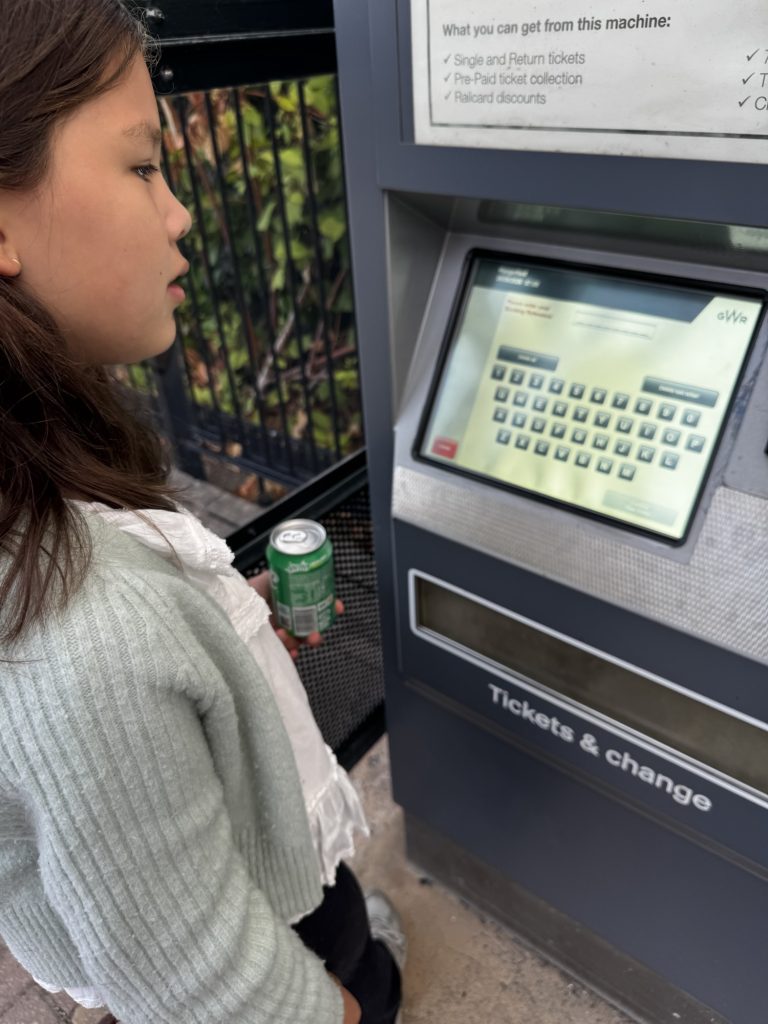
Then came the announcement.
The train was delayed because of a police incident.
Harriet immediately became interested.
“What police incident?”
Grandad Bryan had no idea.
That did not stop Harriet.
Within seconds she was developing theories. Perhaps somebody had stolen something. Perhaps there had been a chase. Perhaps somebody was hiding from the police.
Grandad Bryan realised something while listening to her.
Harriet talks quite a lot when she is excited.
She also talks quite a lot when she is anxious.
At that moment she was both.
Around us stood the regular commuters, quietly staring at phones, coffees and the distant railway line.
Nobody was talking.
Then there was Harriet.
Talking enough for everybody.
Every so often another commuter glanced in our direction with the curious expression of someone wondering why a small person had suddenly appeared in the normally silent world of the morning commute.
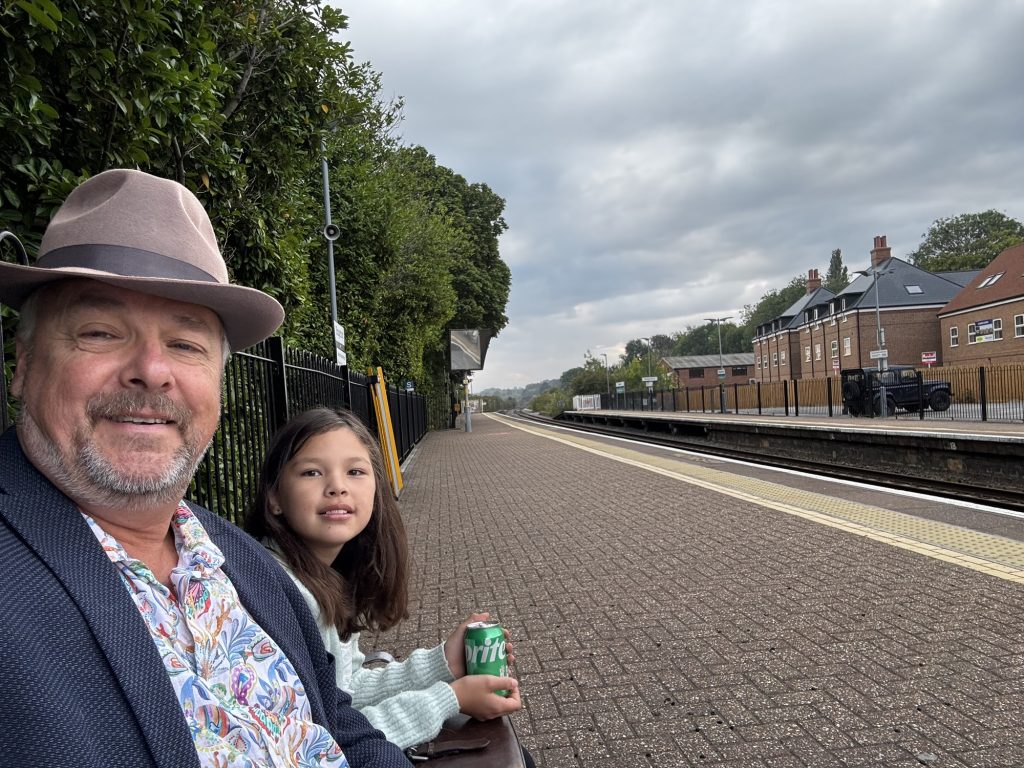
Eventually our delayed train appeared and we climbed aboard.
We found two empty seats, settled down and immediately discovered that we were travelling backwards.
There is something slightly odd about travelling backwards to work. The countryside seems to be disappearing away from you while your body insists you are going forwards.
Harriet opened her new Fireborn book.
Grandad Bryan opened his laptop and began writing stories.
Around us, the carriage was almost completely silent. People were reading books, working on laptops or staring into phones. Everyone had created their own little travelling bubble.
Harriet disappeared into hers.
The train was a fast one to Paddington, and by the time London began appearing outside the windows she was already on Chapter Six.
Grandad Bryan began to suspect that another emergency visit to the White Horse Bookshop might be required before she went home.
A Bear, a Clock and a Man Who Never Gets a Tea Break
Arriving at Paddington meant only one thing.
We had to find Paddington Bear.
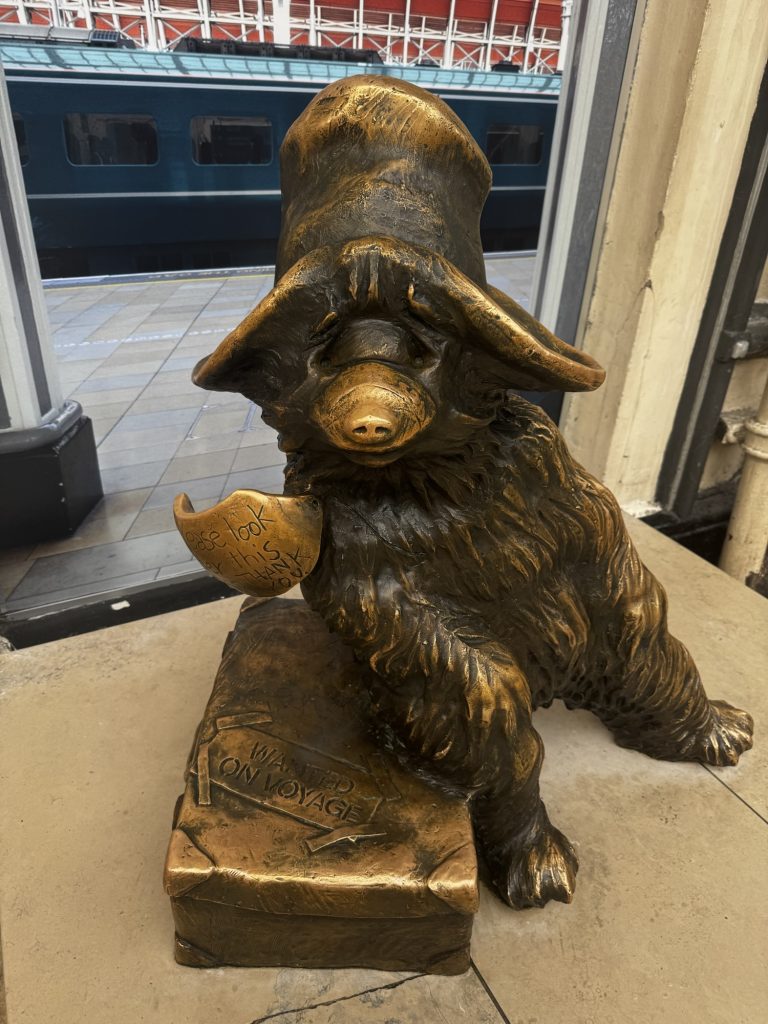
Grandad Bryan was slightly disappointed that there didn’t appear to be any marmalade sandwiches lying around the station, but Harriet found the bronze Paddington and rubbed his nose for good luck.
Thousands of people have apparently had the same idea, because his nose is now wonderfully shiny.
Then we found something considerably stranger.
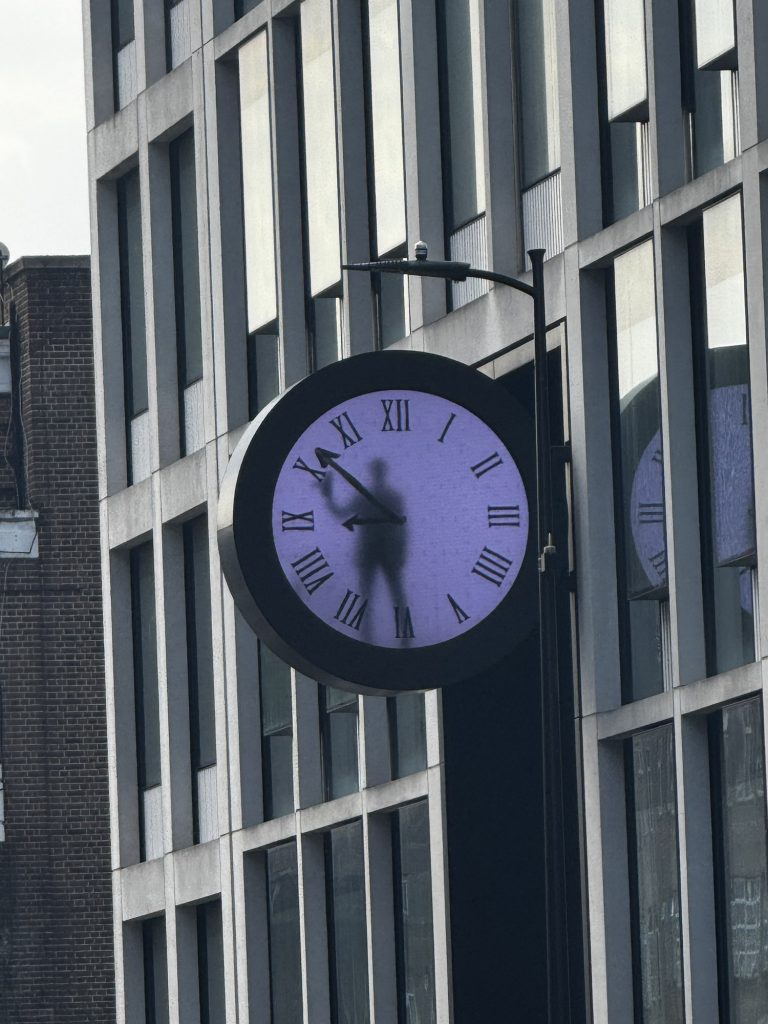
A large clock with what looked like the shadow of a real man trapped inside it.
Harriet stopped to watch.
The man appeared to wipe away one of the clock hands and then repaint it in a slightly different position.
A minute later he did it again.
This was Maarten Baas’s Real Time clock.
It isn’t a normal mechanical clock at all. What you are watching is a twelve-hour filmed performance shown on a screen. The man appears to maintain the clock by physically erasing and repainting its hands, minute after minute, so it always shows the correct time.
He is dressed in nineteenth-century clothing, which connects the work back to Paddington’s Victorian railway history and the age of Isambard Kingdom Brunel.
The effect is brilliant.
It genuinely looks as though there is a poor bloke inside the clock whose job is to keep London running on time with a paintbrush.
Harriet watched him.
Grandad Bryan wondered whether he got a lunch break.
Into the City
We travelled across London towards the office, and the buildings around us became taller, shinier and much harder to fit into a photograph.
Harriet kept looking upwards.
Some of London’s towers rise so steeply above the streets that you need to bend backwards just to see the top.
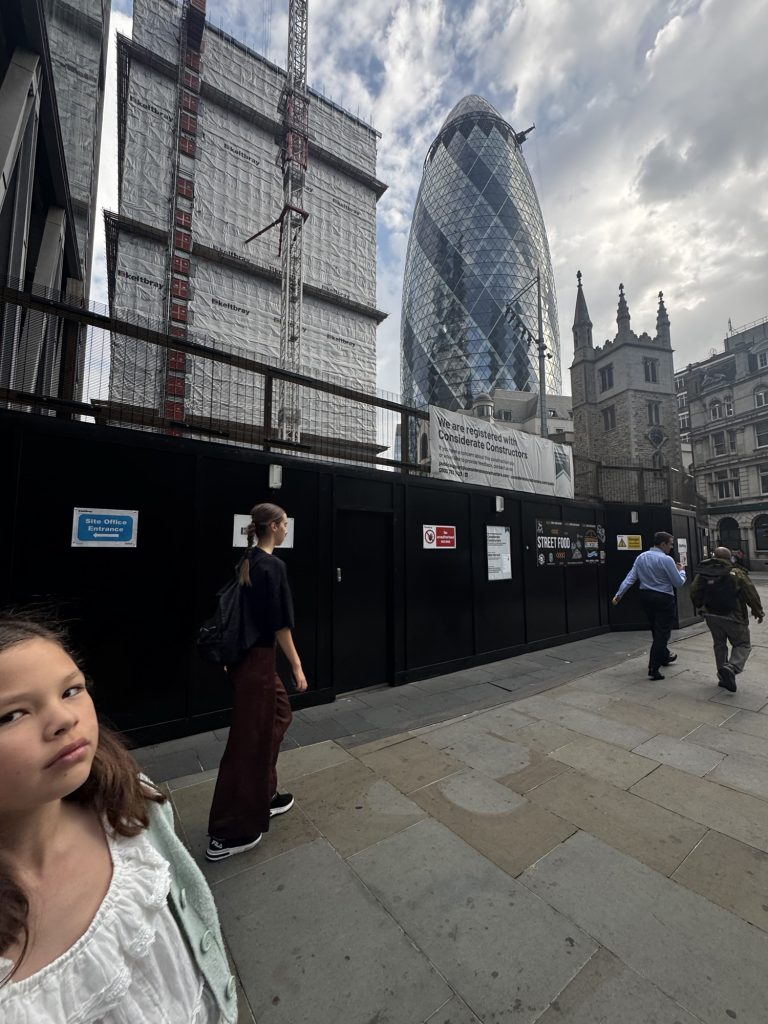
We saw the Gherkin, which remains one of the finest examples of London spending an enormous amount of money on a skyscraper and then naming it after a pickle.
Nearby were the Walkie Talkie, the Shard and the building Grandad Bryan insists looks like something Batman would live in.
There was one slight problem with this.
Harriet has never watched Batman.
“It looks like a Batman building,” Grandad Bryan explained.
“What does a Batman building look like?”
Grandad Bryan considered this.
“Well… like that.”
The architectural discussion ended there.
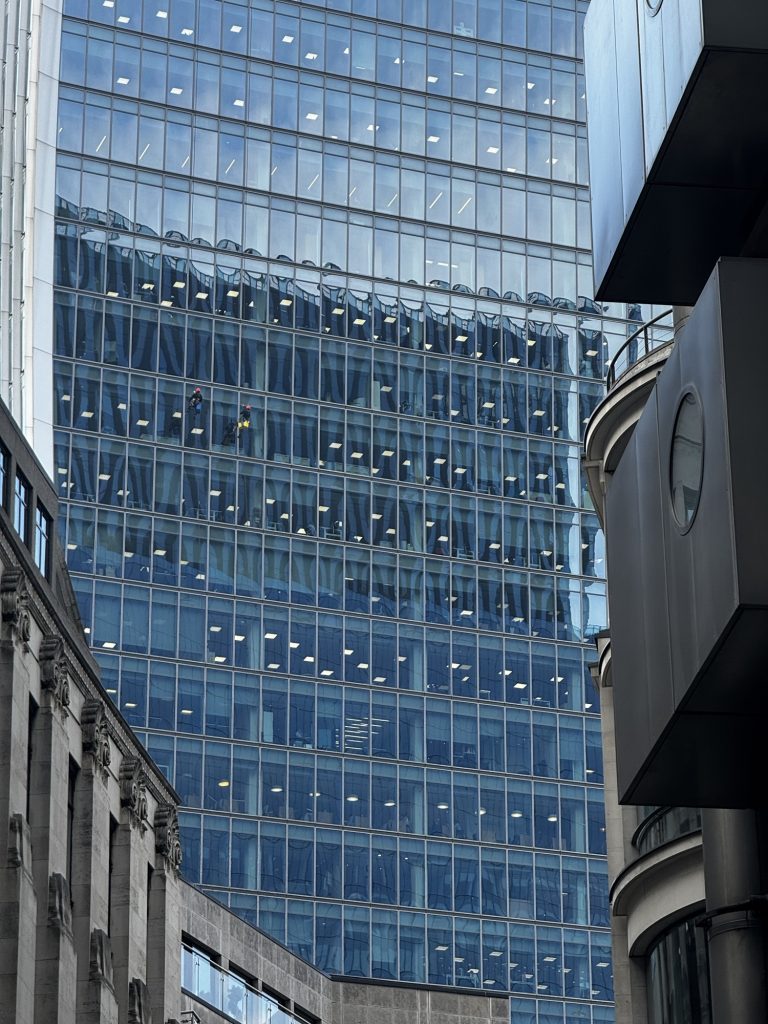
We even spotted two tiny figures hanging from the side of another glass tower.
They were window cleaners.
Harriet stared up at them.
It is one thing cleaning your bedroom window.
It is quite another doing it while dangling hundreds of feet above London.
Harriet Arrives at Work
Eventually we reached Grandad Bryan’s office.
There was one problem.
Grandad Bryan had a pass.
Harriet did not.
We stood waiting while people who clearly knew where they were going wandered through the barriers around us.
Eventually we went up to the third floor and managed to arrange a proper visitor pass.
Harriet was officially allowed into the workplace.
She even got the red VISITOR lanyard.
This seemed to make the whole thing properly serious.
We found a desk, Grandad Bryan opened the laptop and Harriet began her first important piece of professional work.
She created a fish.
The application was called Prompt a Fish.
You described the fish you wanted, artificial intelligence created it, and then it appeared swimming in a shared digital aquarium with everybody else’s fish.
Harriet made hers.
Then we refreshed the screen.
More fish appeared.
Big fish.
Tiny fish.
Round fish.
Bright pink fish.
Fish wearing things no sensible fish would ever wear.
Some looked vaguely normal.
Others looked as though evolution had become bored and started experimenting.
Paul explained that information about the fish was stored separately, which meant that when the screen refreshed it could retrieve everybody’s creations and put them together in the same aquarium.
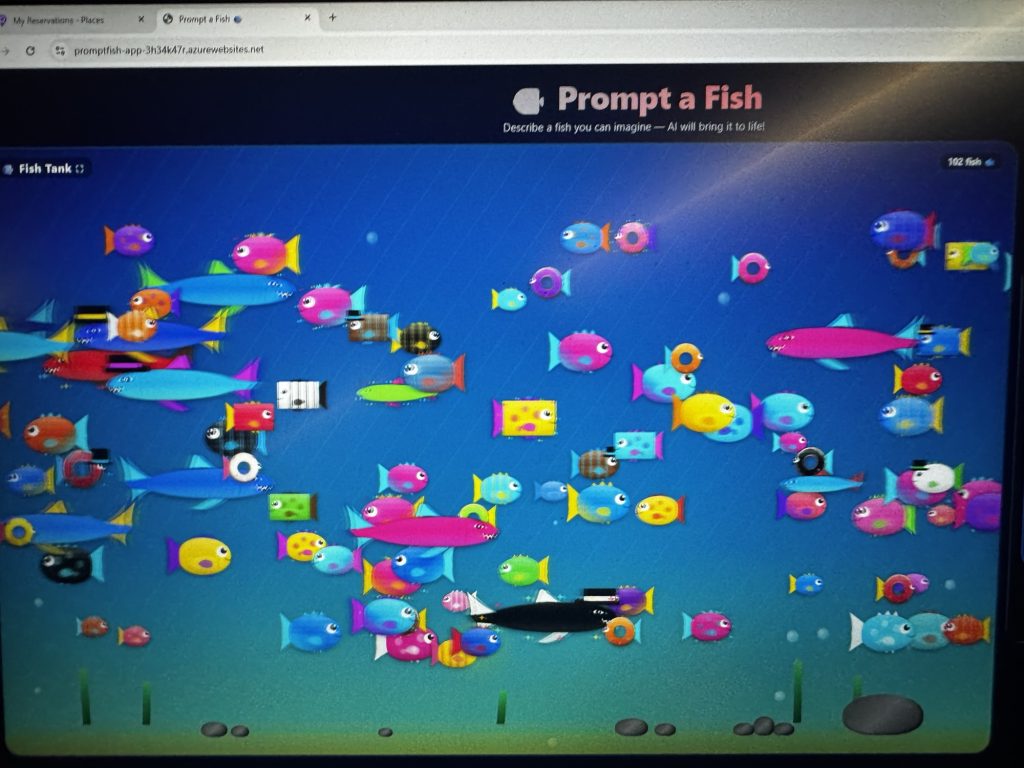
This was a surprisingly good way of explaining software to children.
Forget databases.
Forget cloud services.
Just show them a hundred silly fish.
Can AI Make a Burger?
Later, Paul ran a session about artificial intelligence.
He showed us a series of pictures and asked everyone the same question.
“Real or AI?”
Some were easy.
Others weren’t.
Then he showed us a burger.
It looked completely real.
The bun looked soft.
The cheese looked melted.
Everything was where it should be.
Most people thought it was a photograph.
It wasn’t.
AI had generated the whole thing.
The burger had never existed.
This seemed deeply unfair.
Technology had successfully developed food that looked delicious but couldn’t be eaten.
Harriet had already demonstrated that she had strong opinions about food, so this was clearly dangerous territory.
Paul also talked about how artificial intelligence can help people create software, generate images and write code.
At one point somebody produced a cartoon picture of Grandad Bryan swimming underwater and meeting a reindeer.
Why was the reindeer underwater?
Nobody knew.
Nobody asked.
Sometimes the best use of advanced technology is simply discovering what Grandad Bryan looks like swimming past Rudolph.
Pizza Beneath the Skyscrapers
Lunch was pizza.
This received a considerably warmer response from Harriet than the previous day’s Greggs corned beef bake.
After eating, we headed outside for a walk through the City.
We wandered towards the Tower of London and looked across the skyline.
The Shard rose sharply in the distance.
The Walkie Talkie curved above the streets.
The Gherkin squeezed between modern construction sites and much older stone buildings.
London seemed to have been built by several different people who had never once spoken to each other.
Medieval church?
Keep it.
Glass pickle?
Put it next door.
Building covered in enormous pipes?
Perfect.
Giant shard of glass?
Find a gap.
Somehow it works.
The Jelly Baby Engineering Disaster
Back at the office, it was time for team building.
Each group was given materials and challenged to build the tallest tower.
One of the materials was jelly babies.
This was a mistake.
Grandad Bryan picked one up.
Then ate it.
Someone pointed out that they were supposed to be used for construction.
Grandad Bryan ate another one.
Harriet attempted to build while the project’s material budget steadily disappeared into Grandad Bryan.
There are many recognised risks in major engineering projects.
Weather.
Budget.
Supply problems.
Planning permission.
Very few project plans include:
Grandad keeps eating the building.
The Office Tour
Later we were taken on a tour of the office.
This was where Harriet discovered one of the best bits of modern office design.
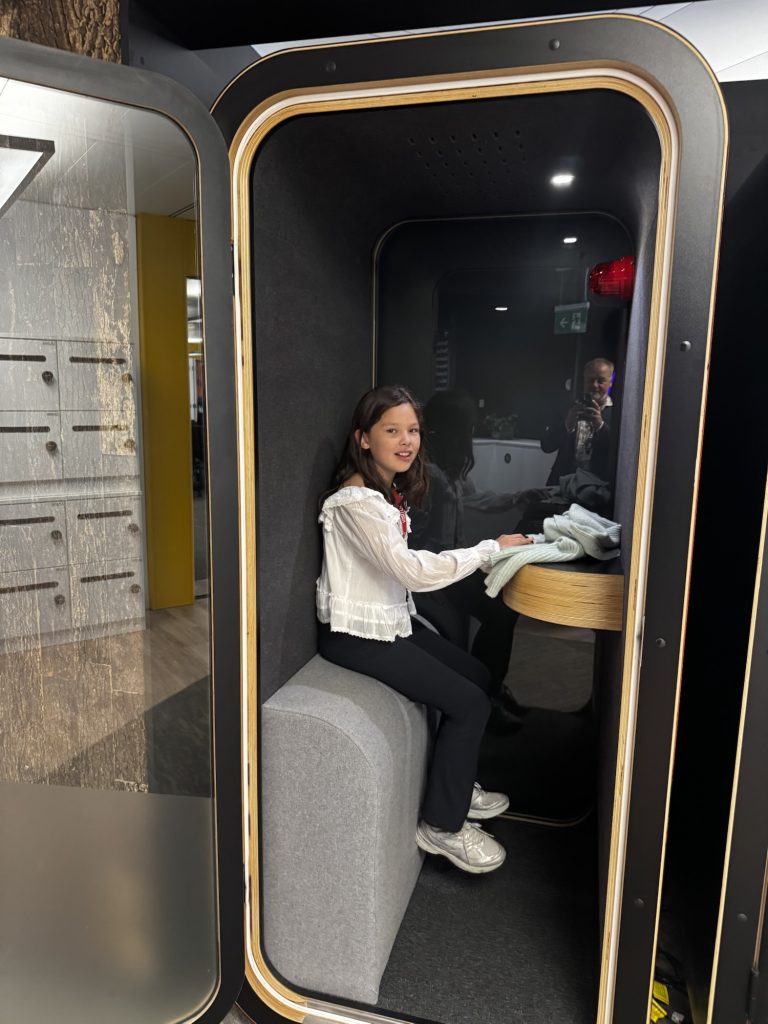
Soundproof phone booths.
They are small enclosed pods where somebody can sit and take a call without disturbing everyone around them.
To an adult, this is a useful workplace feature.
To a group of children, it means only one thing.
“Can we scream inside it?”
There was really only one scientific way to test whether it was properly soundproof.
Harriet climbed inside.
The door closed.
She screamed.
Outside, we could barely hear a thing.
This was excellent engineering.
Grandad Bryan briefly wondered whether Currys sold them for home use.
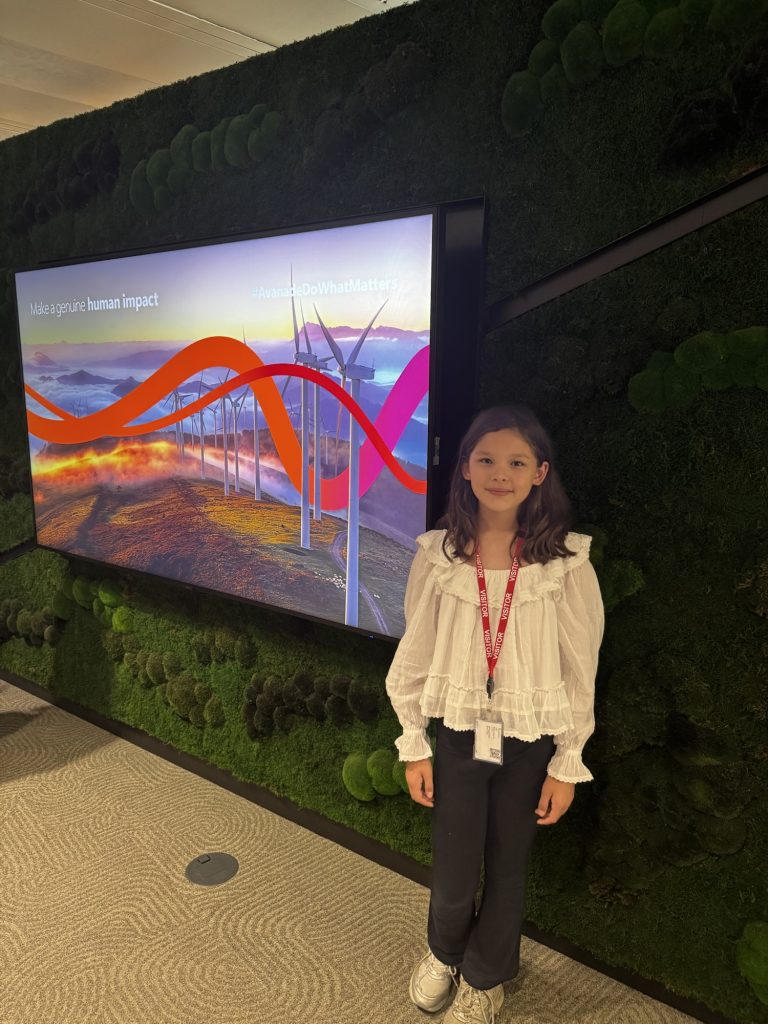
The tour continued through a green area, where one wall was covered in soft moss-like planting and enormous screens showed bright landscapes.
There was fruit.
There were cakes.
There was coffee.
And through the windows you could look out towards some of London’s tallest buildings.
Harriet stood in front of the green wall wearing her visitor pass, now looking quite at home.
And then there was the fish tank again.
By now everybody had been adding creations.
The screen had become a glorious traffic jam of artificial sea life.
There were blue fish, yellow fish, pink fish, enormous fish and several creatures that looked as though biology had formally refused responsibility for them.
Harriet’s was swimming somewhere among them.
Harriet Fixes the World
The final session was with Martin, who talked about smart cities.
He explained how technology could be used to make cities work better and asked the children to think about problems their own imaginary city might solve.
Harriet selected a small and manageable problem.
Poverty.
Nothing too ambitious for Wednesday afternoon.
Her city would make education free.
Energy would be free.
Water would be free.
Healthcare would be free.
But Harriet’s idea wasn’t simply that somebody should endlessly pay for all of it.
She wanted innovation and technology to make these services sustainable so they could be available to everybody without leaving people behind.
Then she came up with the objective for her city.
She wanted to remove two words from the dictionary.
Poverty.
And work.
Grandad Bryan looked at her.
The first objective was admirable.
The second sounded suspiciously useful to a ten-year-old who had spent Tuesday sleeping until 10.30am.
But there was something lovely about the way she approached the problem.
Adults talk about smart cities and immediately start thinking about sensors, traffic systems, artificial intelligence, energy networks and infrastructure.
Harriet started with people.
Can they learn?
Can they get healthcare?
Can they have clean water?
Can they afford to live?
Perhaps the cleverest part of a smart city isn’t the technology at all.
Back to Paddington
At around 3.30pm, it was time to leave.
Harriet opened her book almost immediately.
This presented a new danger.
When Harriet gets deeply into a book, the outside world gradually stops existing.
People can speak to her.
Announcements can be made.
Stations can pass.
Harriet continues reading.
If she travelled alone, there was a reasonable chance she would eventually look up six hours later and discover she was somewhere completely unexpected.
Fortunately, on the journey towards Paddington, the final stop actually was Paddington.
Even Harriet couldn’t accidentally miss it.
We arrived earlier than expected and managed to catch an earlier train back towards Hungerford.
There was no running across the bridge.
No dramatic last-second arrival.
No Grandad Bryan collapsing into the carriage out of breath.
We simply boarded like normal people.
It felt very strange.
Harriet settled into her seat and returned to Fireborn.
Grandad Bryan sat beside her while London slowly gave way to suburbs, fields and countryside.
We would be home before six.
Harriet had started the morning carrying a leather briefcase and drinking Sprite on a cold railway platform.
By the end of the day she had met Paddington Bear, watched a man apparently repaint a clock, walked beneath London’s skyscrapers, created an AI fish, investigated a fake burger, screamed inside a soundproof booth, helped construct a jelly-baby tower and designed a smart city intended to abolish poverty.
Grandad Bryan had mostly drunk coffee, taken photographs and eaten some of the construction materials.
So after spending a full day together in the office, there was really only one question.
Which one of them had actually done the most work?
Harriet didn’t answer.
She was already reading the next chapter.