Travel journal
Forbidden Grapes, Blueberries and a Winemaker Who Would Not Behave
16 July 2026
Vin Nu
Some vineyard tours begin with a polished tasting room and a speech about terroir.
Ours began outside a weathered wooden barn with four white folding chairs, a black sign saying VIN NU, and the strong sense that we had arrived somewhere European wine law preferred not to discuss.
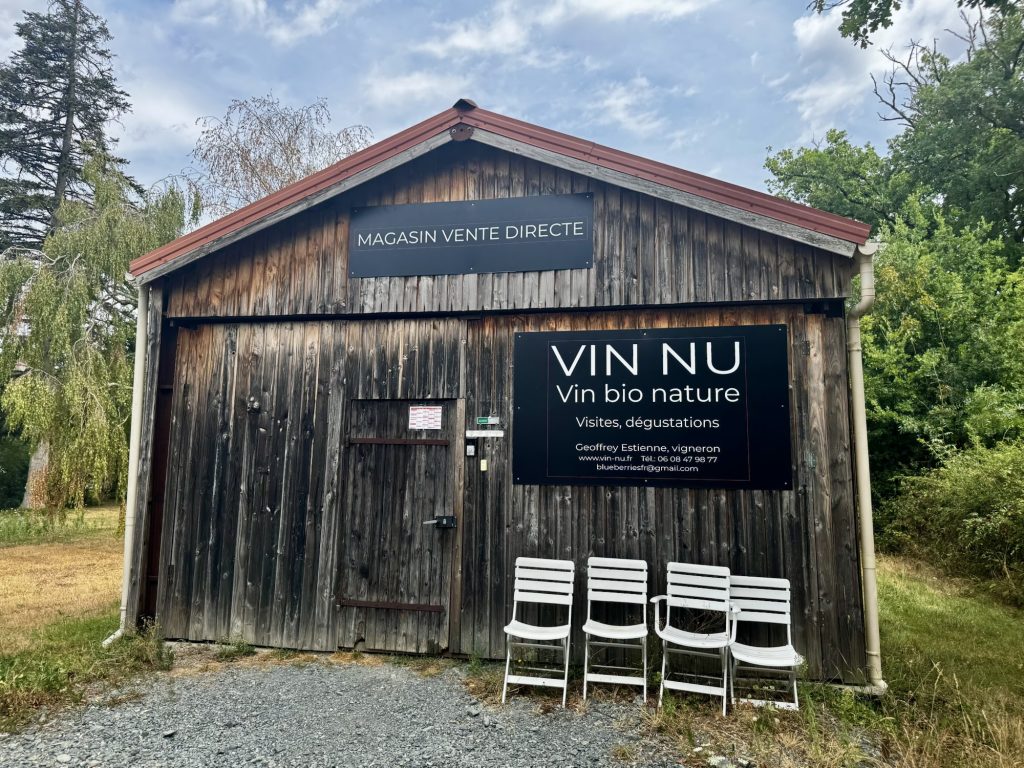
The sign promised natural organic wine, direct sales, visits and tastings. There were no stone lions, ornamental fountains or staff wearing aprons with embroidered logos. Just timber darkened by weather, dry grass, a gravel path and a building that looked as though it had spent years quietly minding its own business.
Inside, however, was Geoffrey Estienne.
Geoffrey was dressed almost entirely in black and had one arm held in a sling. This appeared to inconvenience him only slightly. He still pointed at vines, lifted leaves, opened bottles and explained complicated European regulations with his free hand. At several points he seemed to forget the injured arm altogether, which made the rest of us increasingly nervous on its behalf.
Dana and I followed him out towards the vineyard.
The rows ran down the hillside in disciplined green lines, but the ground beneath them was the colour of toast. Dry grass crackled under our feet. The vines were full and leafy, yet everything below waist height looked as though it had been placed beneath a grill.
The sky was pale and hazy, with a few clouds attempting to look useful.
They were not.
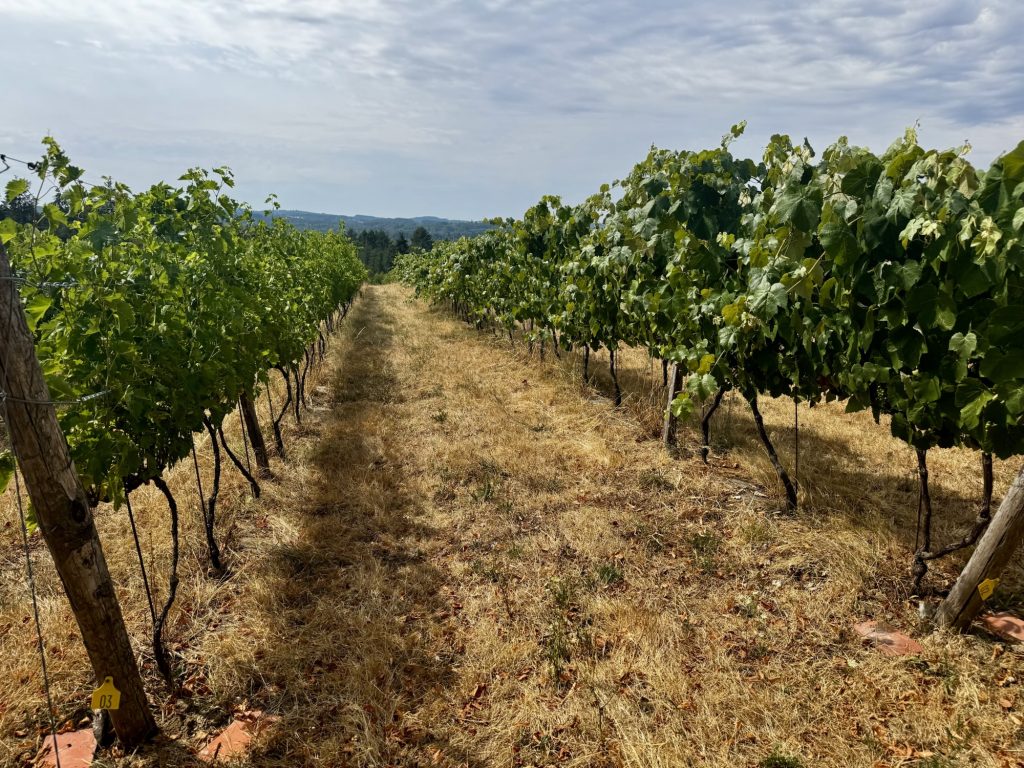
From a distance the vineyard looked lush. Up close, the heat was written everywhere. Leaves drooped at the edges. Clover between the rows had turned brown. The soil felt dusty and tired.
Geoffrey stopped beside one vine and lifted a large leaf.
Dana leaned in to listen. I stood nearby adopting the expression of a man who definitely understood viticulture.
“This field was planted in 2024,” Geoffrey explained.
The plants were only two years old, though technically in their third year of life because they had already spent a year growing before being planted. Small clusters of grapes hung beneath the leaves, hopeful and vulnerable.
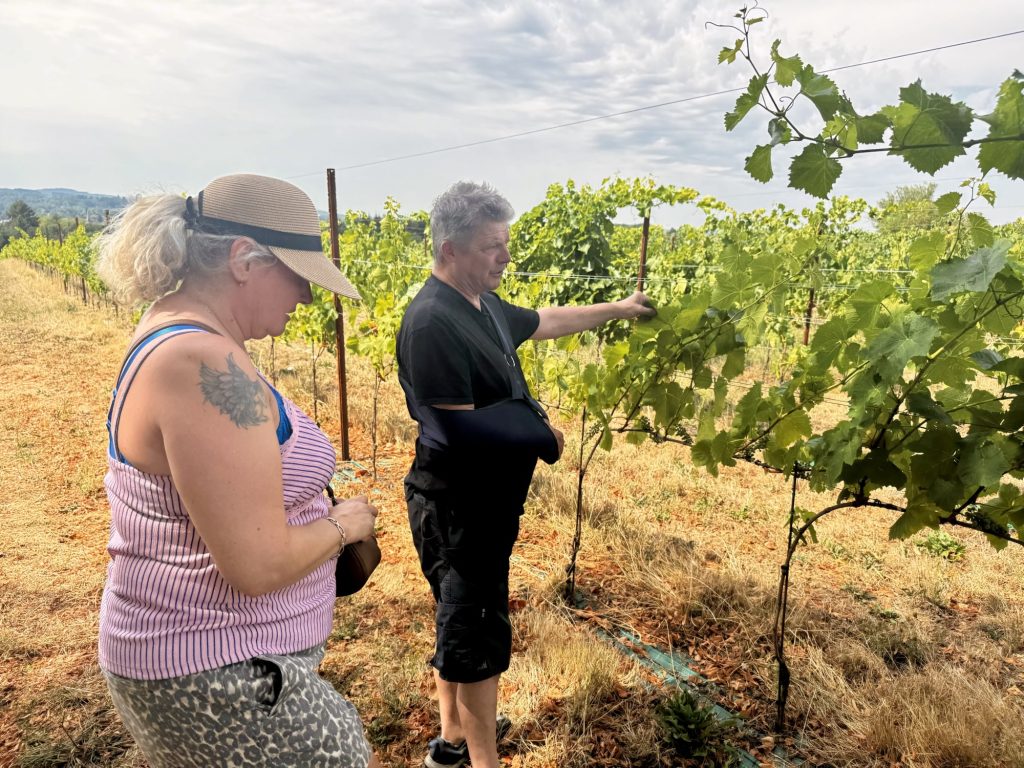
Geoffrey explaining the young vines while Dana sensibly listened and I pretended to understand.
“If there is no rain before the end of the month,” he said, “I will cut off all the grapes.”
“To harvest them?” I asked.
“No. To save the vines.”
That changed the mood.
The young plants were using precious water to produce fruit. If the drought continued, Geoffrey would remove the grapes so the vines could direct what little strength they had into surviving.
It was not an economic calculation made in an office. It was a decision standing right there on the hillside.
Whole rows of potential wine might have to be sacrificed before harvest.
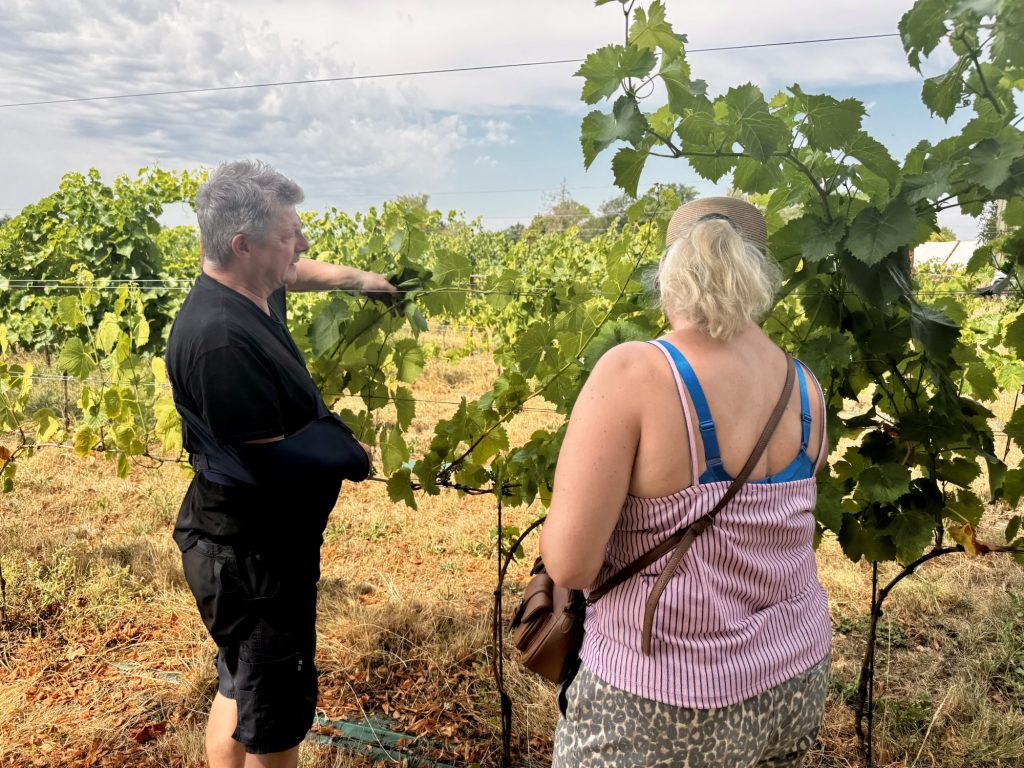
Geoffrey explained that this area had once been too cold for traditional European grapes. Winters regularly dropped below the temperatures many varieties could tolerate.
Now the problem was heat.
“Normally,” he said, “we like British weather.”
I looked at Dana.
This was the first time I had heard anyone say that without irony.
The summers had become hotter and the seasons less predictable. Grapes that would normally ripen in September or October were developing far earlier. Based on the timing of the flowers, Geoffrey thought some might ripen around the middle of August.
He had never seen it happen so soon.
The vineyard was adapting faster than the rules governing it.
A decade spent looking for the right grapes
Before planting, Geoffrey had spent about ten years researching grape varieties and growing conditions around the world. He had studied vineyards in Canada, Chile, Central Europe, Nepal, Indonesia, Romania, Ukraine and Moldova.
He was searching for vines that could survive disease naturally.
Traditional European wine grapes such as Chardonnay, Sauvignon Blanc and Merlot are vulnerable to fungal diseases including mildew and oidium. Without repeated treatment, entire crops can be lost.
Geoffrey wanted something different.
He began planting old and resistant varieties that had inherited natural protection from American grape species.
The names came quickly.
Noah.
Baco.
Concord.
Clinton.
Isabella.
Léon Millot.
Souvignier Gris.
Muscaris.
Taylor.
York Madeira.
After the first ten names, I began nodding as though I had met them all at a conference.
“Ah yes, Clinton. Lovely fellow.”
Some varieties were authorised.
Some were restricted.
Others were prohibited from commercial wine production.
“Forbidden?” I asked.
“Yes.”
Geoffrey smiled.
“I don’t care.”
Dana gave me a sideways glance.
It was the same look she normally reserved for the moment Google Maps sent us along a narrowing farm track and I announced, “This will definitely join the main road.”
The difference was that Geoffrey’s questionable route involved the European Commission.
When grapes became illegal
The restrictions dated back decades. In the 1930s, France was struggling with wine overproduction and several highly productive hybrid varieties were prohibited.
Farmers were required to remove them.
These vines had one awkward advantage - they were extremely resistant to disease. They could grow with little or no chemical treatment. For small farmers making wine for themselves, they were practical and affordable.
Their disappearance helped bring an end to much of that small-scale home production.
Geoffrey believed the old rules had become increasingly difficult to justify. These grapes could be useful in a hotter climate and could reduce reliance on pesticides.
He and others were campaigning for the resistant varieties to be reintroduced legally.
Until then, he had found a characteristically French solution.
Some of his bottles were not sold as wine.
They were described as pressed, fermented grapes.
“It is made from grapes?” I asked.
“Yes.”
“It has fermented?”
“Yes.”
“It contains alcohol?”
“Yes.”
“But it isn’t wine?”
“No.”
That was when I realised we were no longer discussing agriculture.
We had entered administration.
Blueberries, purple mouths and Czech dumplings
The vineyard was not Geoffrey’s only crop.
Nearby was a blueberry farm, and the moment he mentioned it, Dana was transported back to her childhood in the Czech Republic.
“When I was little,” she said, “we went into the forests to pick wild blueberries.”
“Borůvky?” Geoffrey asked.
Dana beamed.
“Yes. Borůvky.”
The two of them immediately began comparing memories.
Dana described using special comb-like tools to gather the berries from low bushes. The fruit was dark purple inside, unlike many of the larger supermarket blueberries that are pale in the middle.
Their fingers turned purple.
Their mouths turned purple.
Everyone returned home looking as though they had shared a particularly violent bottle of ink.
The berries were used to make sweet Czech dumplings, with blueberries tucked inside soft dough and served warm.
For a few minutes, Dana and Geoffrey were no longer standing in a dry French vineyard. They were children in different European forests, collecting the same berries with the same little combs.
Geoffrey had once grown blueberries commercially and supplied large quantities to Britain, including retailers such as Marks & Spencer, Safeway and Morrisons.
He also explained why the crop had once suited the region. Wild blueberries need proper winter cold to flower well in spring.
The winters used to provide it.
Now the climate had shifted enough for grapes to thrive where they once struggled.
Travel has a habit of placing large subjects into very small conversations. Climate change had begun with a discussion about purple mouths and dumplings.
Farming without forcing the land
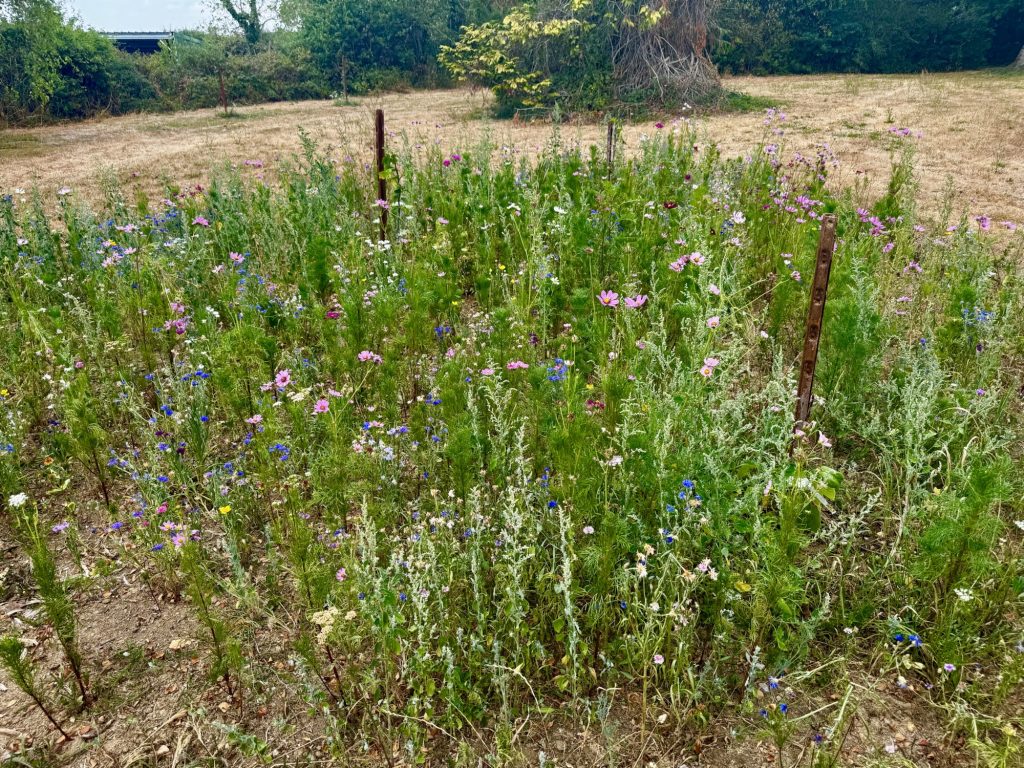
Between the rows, Geoffrey normally grew clover.
The clover captured nitrogen and returned it to the soil, reducing the need for artificial fertiliser. Grass and other plants were not treated as enemies. They formed part of the vineyard’s natural system.
This year, however, even the clover had retreated.
“It is sleeping,” Geoffrey said.
He paused.
“Suffering.”
That one corrected word said more than a long explanation could have done.
The vineyard was certified organic, and Geoffrey produced natural wine. He used no routine chemical fertilisers and wanted the vines, soil, insects and surrounding plants to function together.
He cut the grass between the rows with small machinery but did much of the detailed work by hand.
Pruning.
Training the young plants.
Selecting branches.
Managing the shape of each vine.
The first years mattered enormously. A mistake made while establishing the plant could affect it for the rest of its productive life.
It was painstaking work, made more impressive by the fact that Geoffrey seemed to be doing it while operating with only 50 per cent of the usual number of arms.
The machine that squeezes the grapes
Back inside the production area, the first object that caught our attention was the press.
It stood taller than either of us, with a heavy burgundy frame wrapped around a cylindrical cage of white slats. Chains hung from the sides, the steel surfaces shone under the workshop light, and a large plate waited above to descend.
It looked less like a wine press and more like something used to interrogate agricultural equipment.
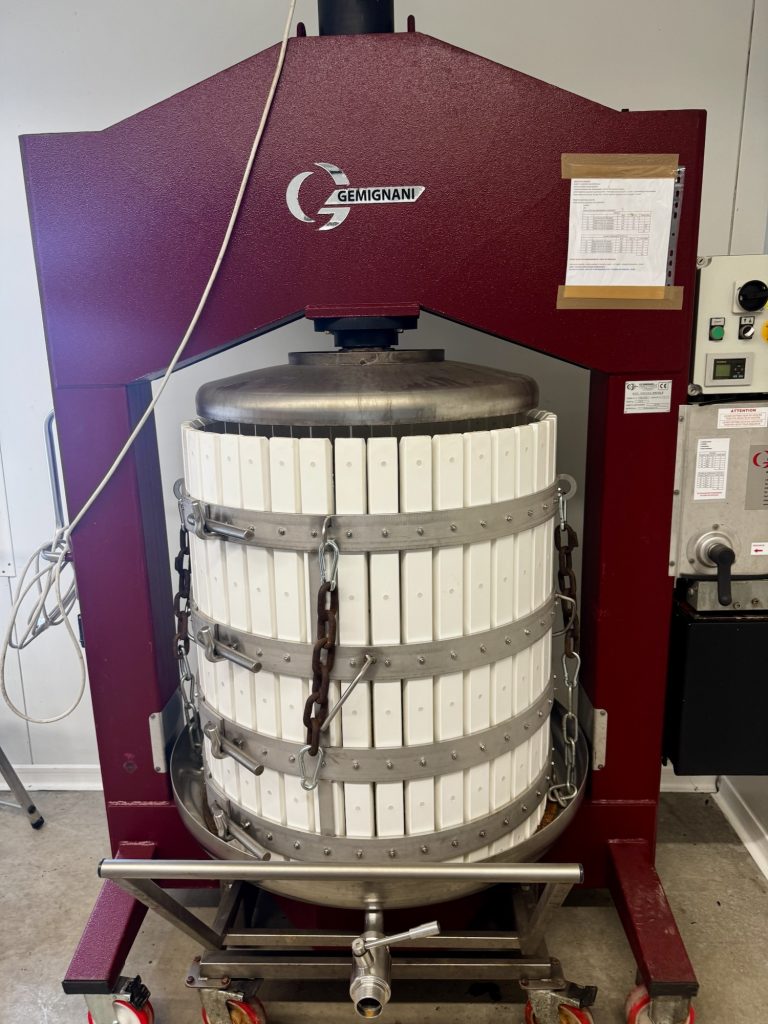
The harvested grapes were placed inside, then pressure extracted the juice through the gaps between the slats.
This was where fruit became must - the sweet grape juice that would eventually ferment.
I looked at the chains, levers and steel frame.
“So you don’t crush them with your feet?”
Geoffrey looked at me.
“No.”
Another traditional image destroyed by machinery and hygiene regulations.
Yeast, bacteria and the threat of vinegar
Geoffrey produced natural wine without relying on added sulphites to control unwanted bacteria.
That meant fermentation had to be watched closely.
Natural yeast arrived on the grape skins from the vineyard. Once the grapes were pressed, those yeasts began converting sugar into alcohol and carbon dioxide.
If the yeast remained healthy, wine developed.
If bacteria took control, vinegar developed.
This seemed a rather thin line on which to build a business.
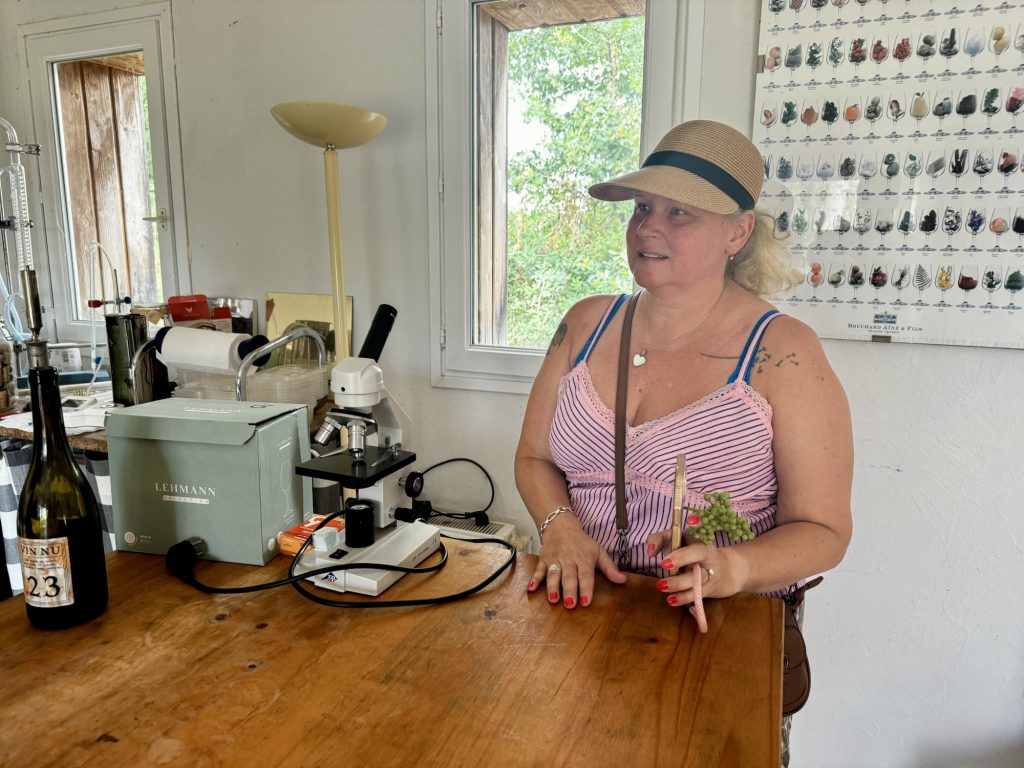
Geoffrey used a microscope to inspect what was happening inside the tanks. He looked at yeast populations, watched for bacteria and adjusted oxygen, temperature and available nitrogen.
It was part farming, part chemistry and part microscopic crowd control.
“You can see the yeast?” Dana asked.
“Yes.”
“And the bacteria?”
“Yes.”
I imagined millions of organisms racing each other around a tank while Geoffrey stood over them like a strict swimming coach.
“Come on, yeast. Keep moving. Don’t let the bacteria through.”
The distillery in the art gallery
Then we entered what might have been the most unusual room on the property.
There were copper pipes, a large red boiler, an old still, pressure gauges and vessels designed to convert fermented fruit into very strong spirits.
Behind them hung framed portraits and paintings.
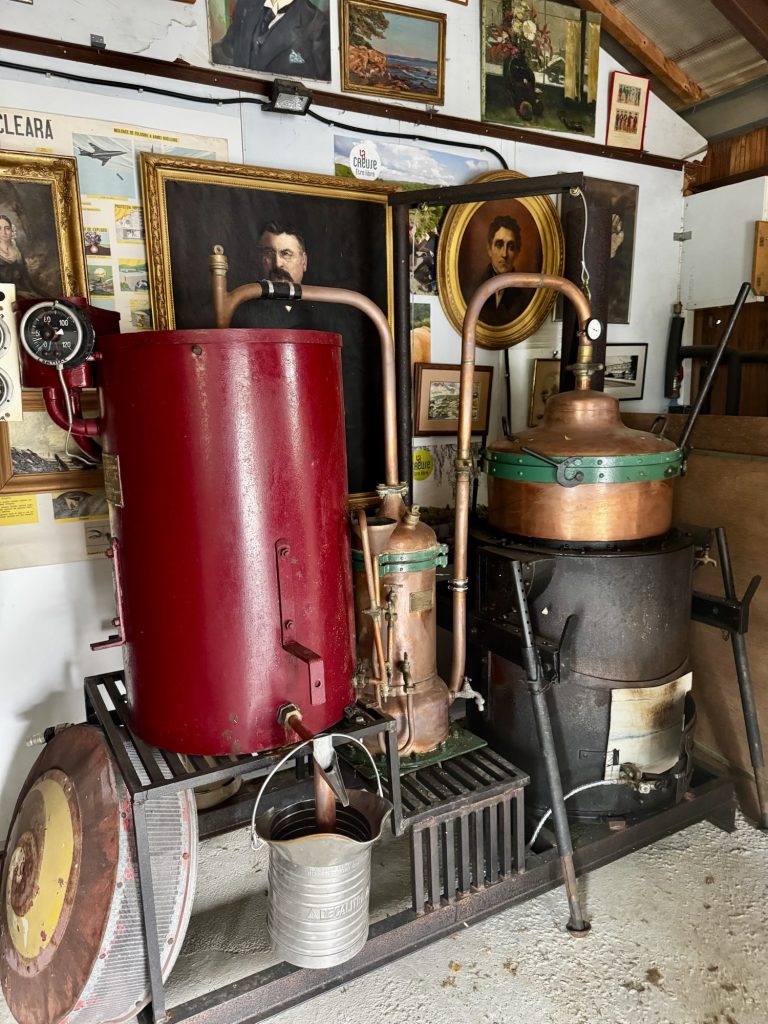
It was a working distillery crossed with an eccentric private gallery.
Copper tubing curved across the room in front of painted gentlemen who looked as though they had been waiting 150 years for someone to explain what was going on.
One portrait stared directly towards the still with the expression of a man who had just discovered his best saucepan had been converted into an aquavit experiment.
Geoffrey produced a range of spirits.
Vodka.
Fruit brandies.
Wild plum spirit.
Pear spirit.
Herbal experiments.
Aquavit inspired by Scandinavia.
He had also experimented with mushrooms.
By this point I suspected that nothing growing within five miles of the farm was completely safe from fermentation.
Dana’s family medicine
Dana told Geoffrey about the spirits she remembered from the Czech Republic.
Her father had made a strong apple spirit similar to Calvados using fruit from his own tree. He stored it in large glass containers and referred to it as medicine.
“For an upset stomach,” Dana explained.
“Of course,” Geoffrey replied.
They both treated this as entirely reasonable.
Across Central and Eastern Europe, home-made alcohol appears to have been prescribed for almost every known condition.
Stomach ache.
Cold weather.
A bad day.
A good day.
Visitors.
Lack of visitors.
The dosage was usually one small glass, followed by another small glass to make sure the first had worked.
Dana also described slivovice, a powerful plum spirit that sometimes came with the fruit still sitting inside the bottle as evidence.
Geoffrey showed us his own spirits, many around 50 or 60 per cent alcohol.
Medicine, apparently, but medicine that could also remove paint.
One hundred kilograms of sloes
Geoffrey had collected roughly 100 kilograms of wild sloes for one of his spirits.
The fruit grew on thorny bushes, so collecting them required long gloves and large cutters. Three people could spend an entire day gathering enough.
The sloes were much larger than those we normally saw in Britain, though they still contained very little flesh around a disproportionately large stone.
Geoffrey explained that the spirit carried an almond-like flavour from the stones.
I mentioned sloe gin.
He corrected me immediately.
Gin came from juniper. Sloe gin was simply gin infused with sloes.
Dana summarised the British process more efficiently.
“You take bad gin, put sloes in it, leave it for a year, then drink it at Christmas.”
There was a pause.
No one challenged her.
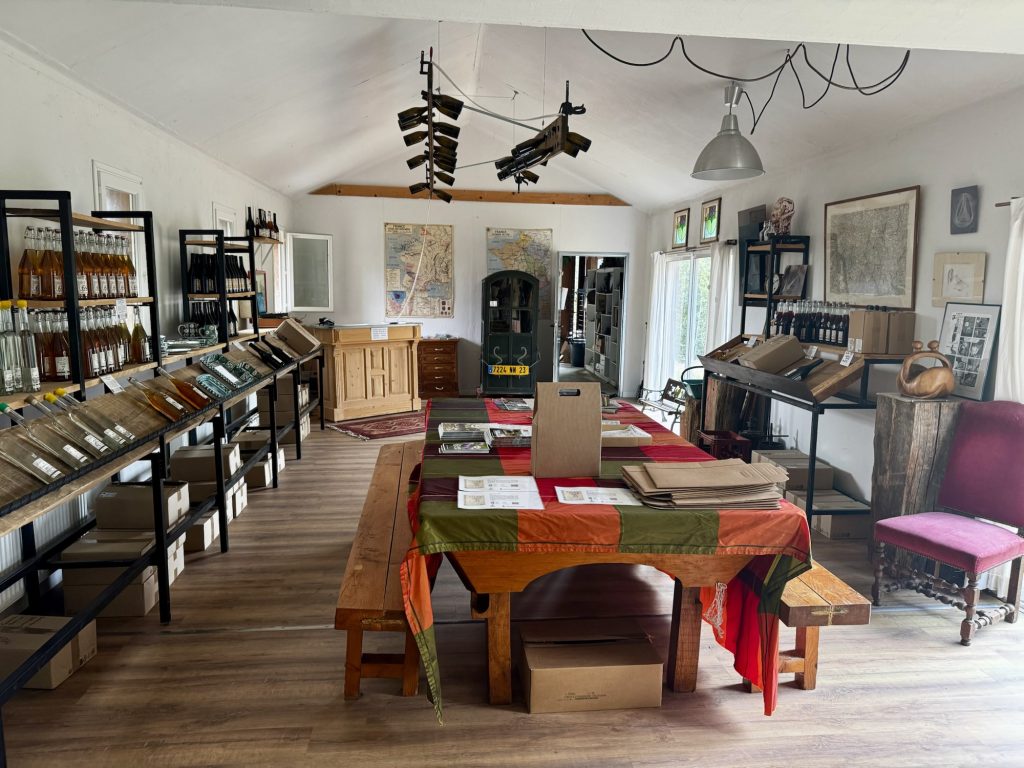
The shop that felt like someone’s very interesting home
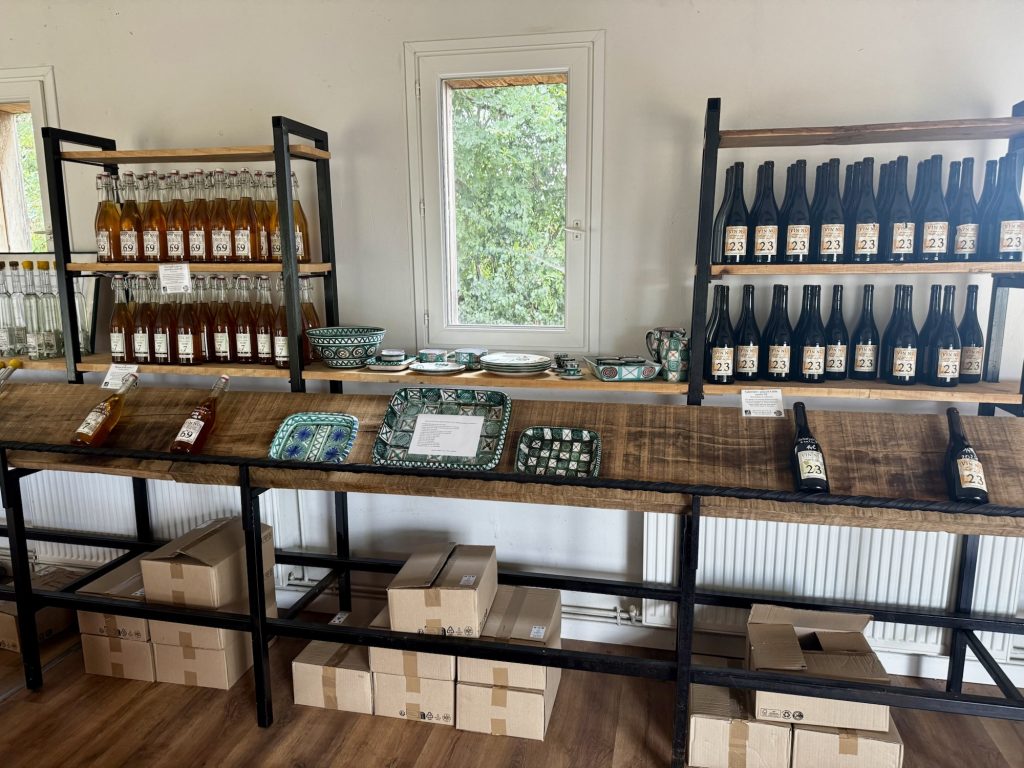
The sales room was bright and welcoming, but it was far from a conventional shop.
Shelves of bottles lined both sides. Cardboard boxes sat underneath, ready for customers. Handmade ceramics were placed between bottles, while old maps, artwork and vintage objects covered the walls.
A long wooden table ran through the centre beneath a colourful cloth.
Suspended overhead were unusual wooden agricultural tools, pieces of equipment and what looked like a small fleet of dismantled inventions.
At one end sat an old green vehicle or railway carriage front with a number plate still attached. Elsewhere stood an antique chair upholstered in bright pink.
It looked as though a wine shop, a family museum and an auction room had agreed to share the same building.
Nothing matched.
Everything belonged.
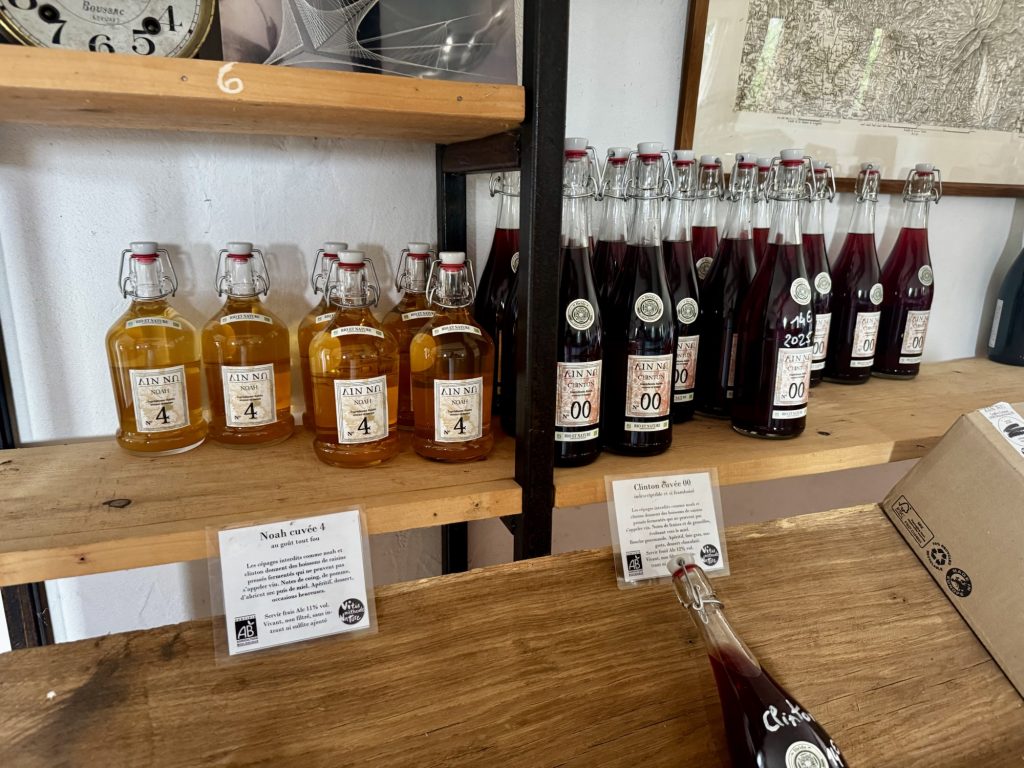
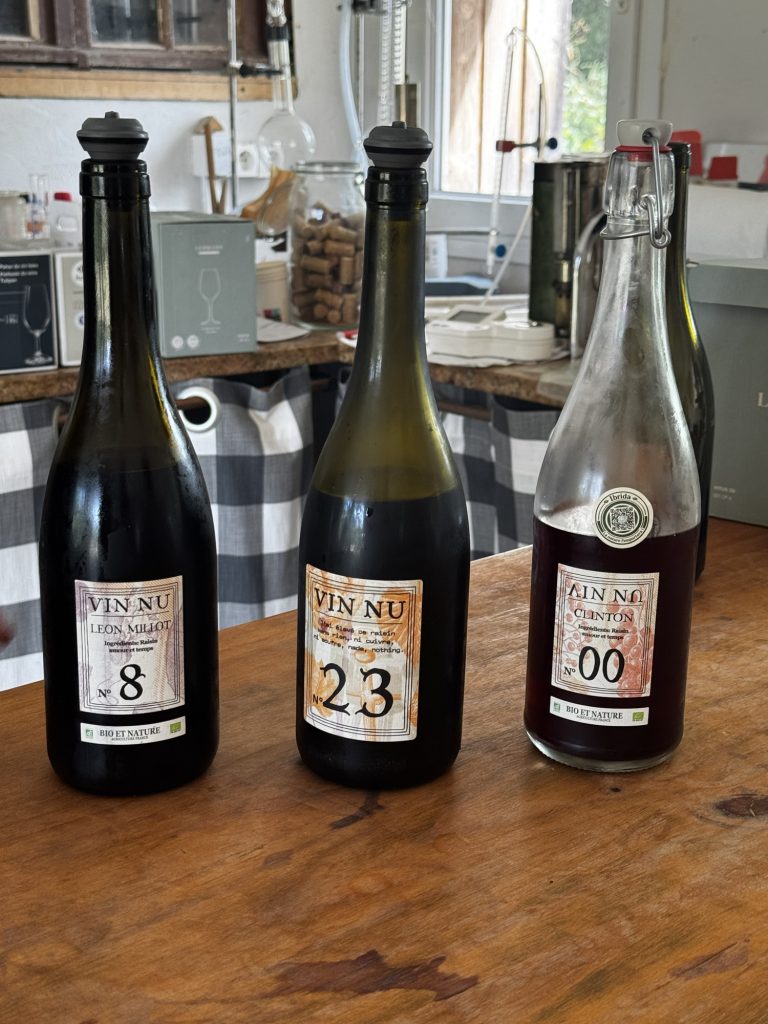
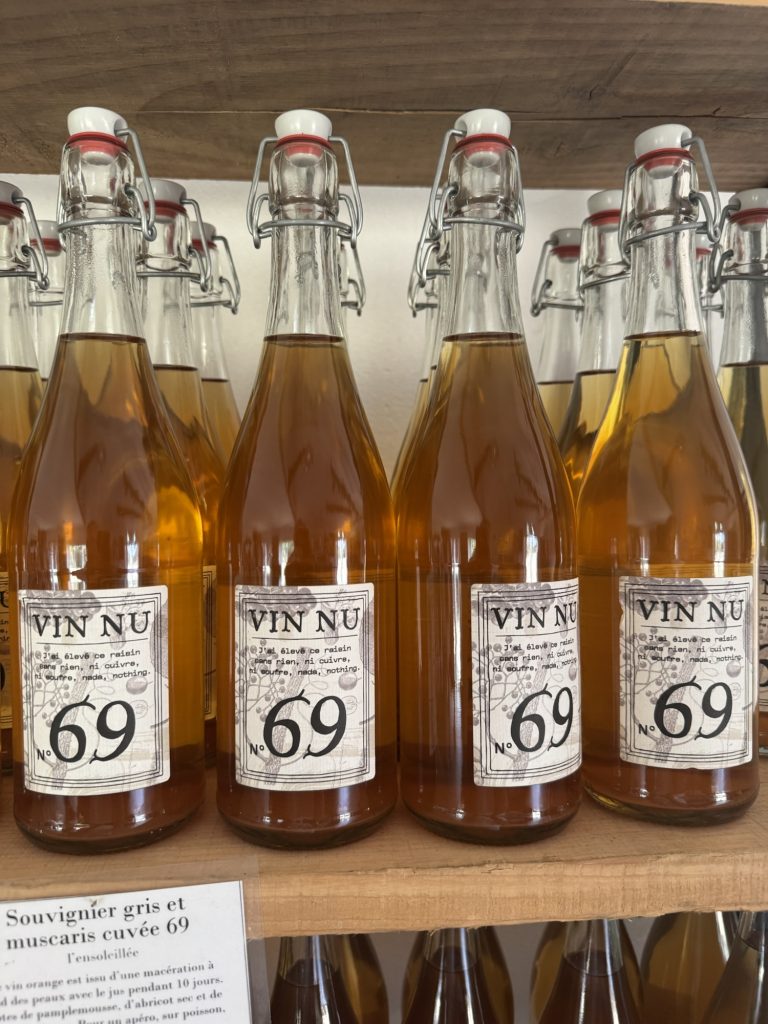
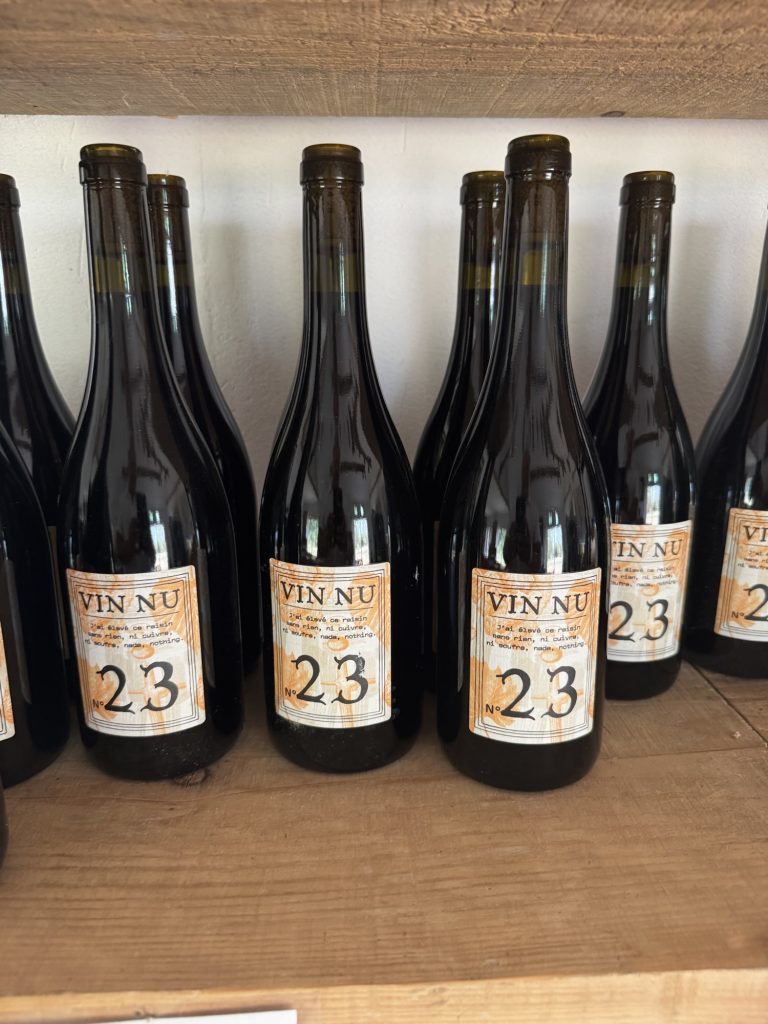
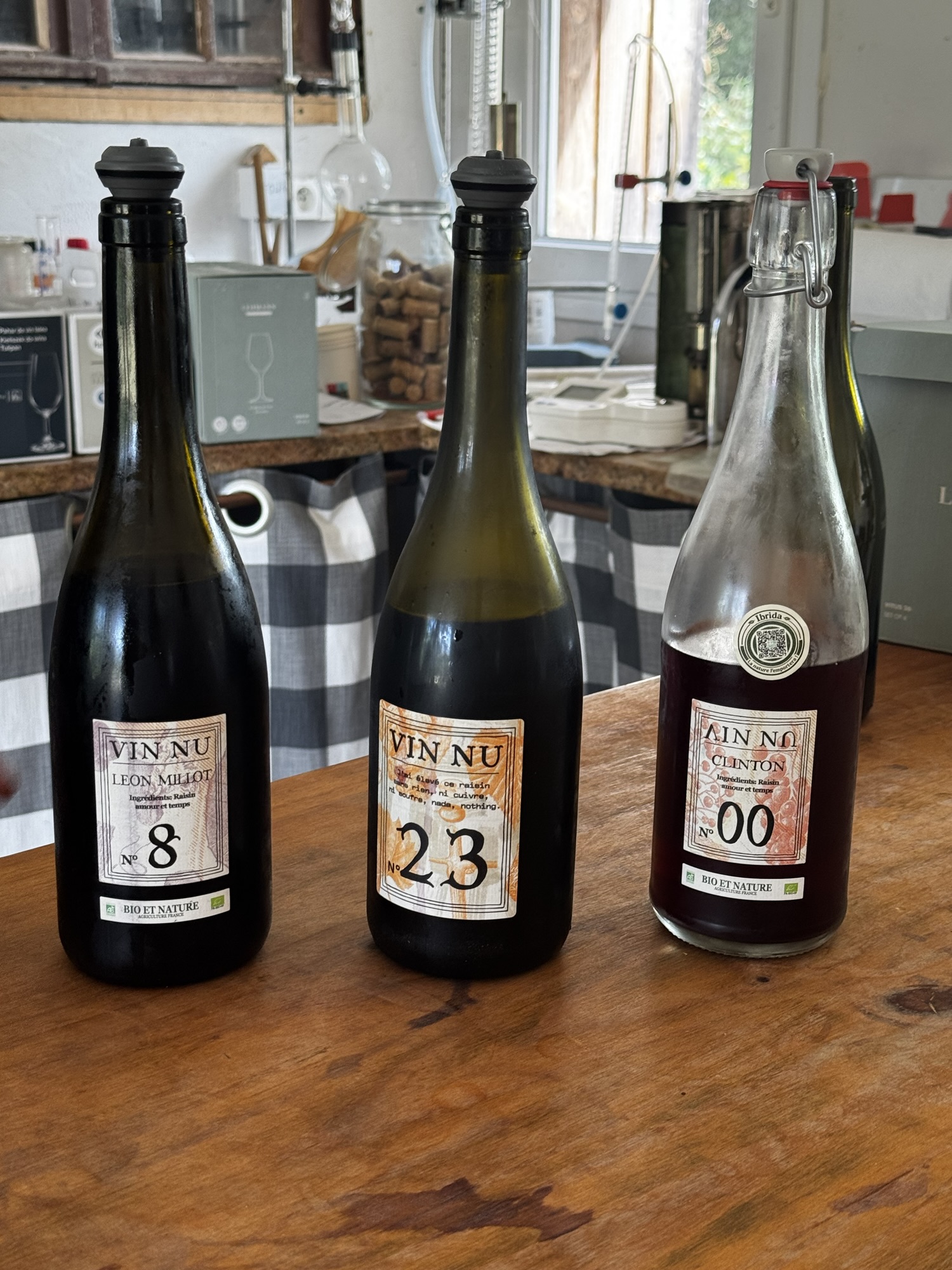
Some bottles were clear, filled with amber or colourless spirits. Others were dark and carried Geoffrey’s distinctive VIN NU labels.
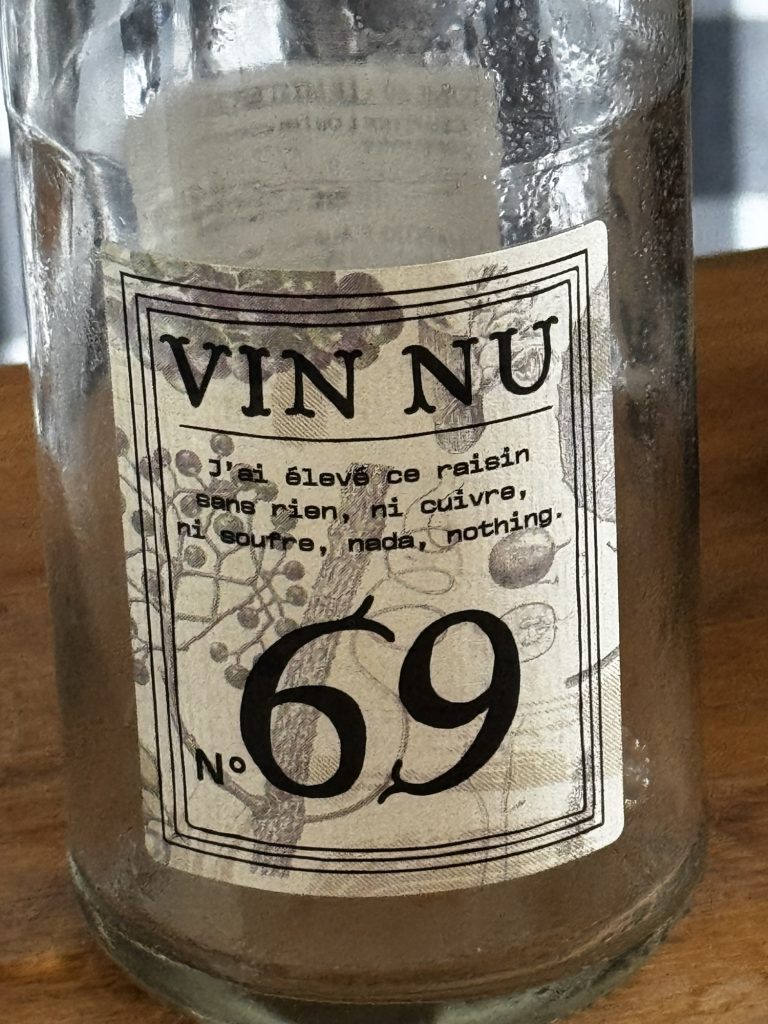
The labels displayed numbers rather than familiar names.
No. 2.3.
No. 6.9.
No. 7.
No. 8.
It gave the shelves the appearance of a beautifully arranged police evidence room.
Why the bottles had codes
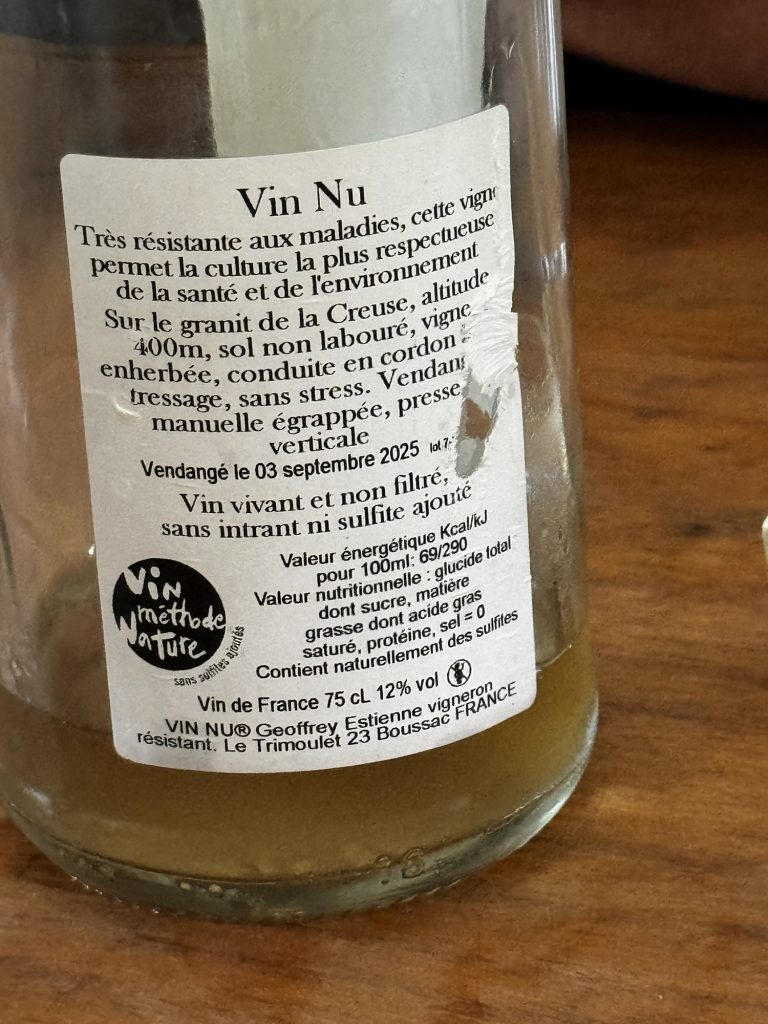
For years, Geoffrey had used numbers to disguise the identity of certain prohibited grape varieties.
He knew what the codes meant.
The customer might know.
The authorities did not.
Bottle 2.3 might represent a blend of two particular varieties. Another number might identify something more controversial.
The labels allowed him to sell the fermented grape product without openly advertising every detail of its forbidden ancestry.
Then Geoffrey appeared on French television and spoke publicly about his work campaigning to legalise the grapes.
After that, hiding the names seemed slightly unnecessary.
“You were on television talking about the prohibited varieties?”
“Yes.”
“And now everybody knows you grow them?”
“Yes.”
“Did that make the codes pointless?”
He smiled.
Not entirely.
The code remained part of the story.
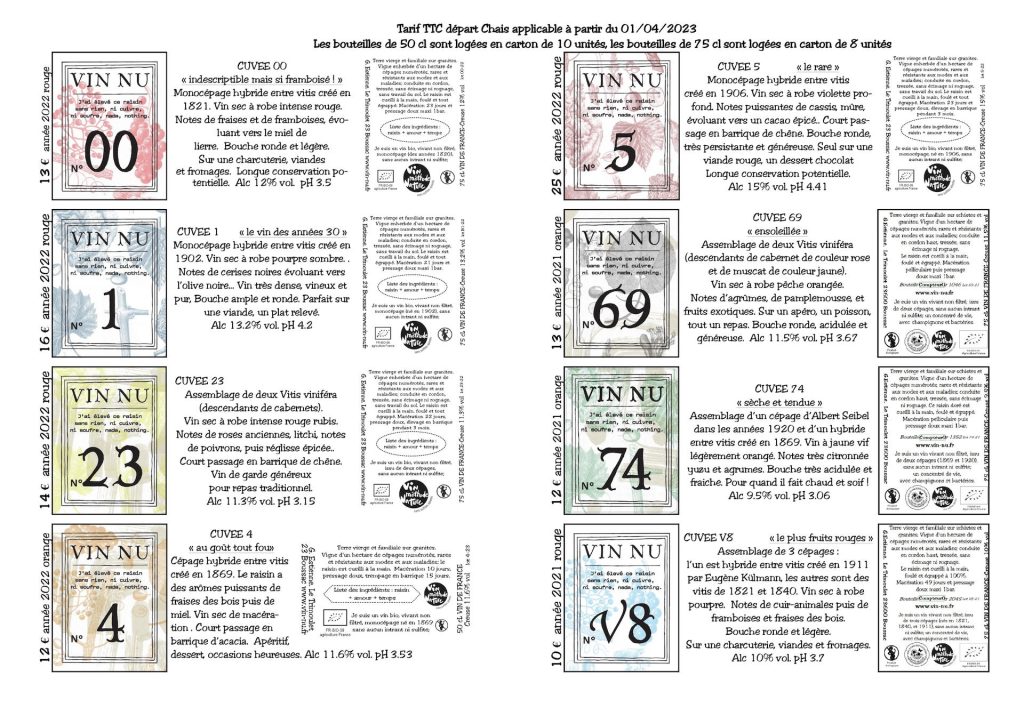
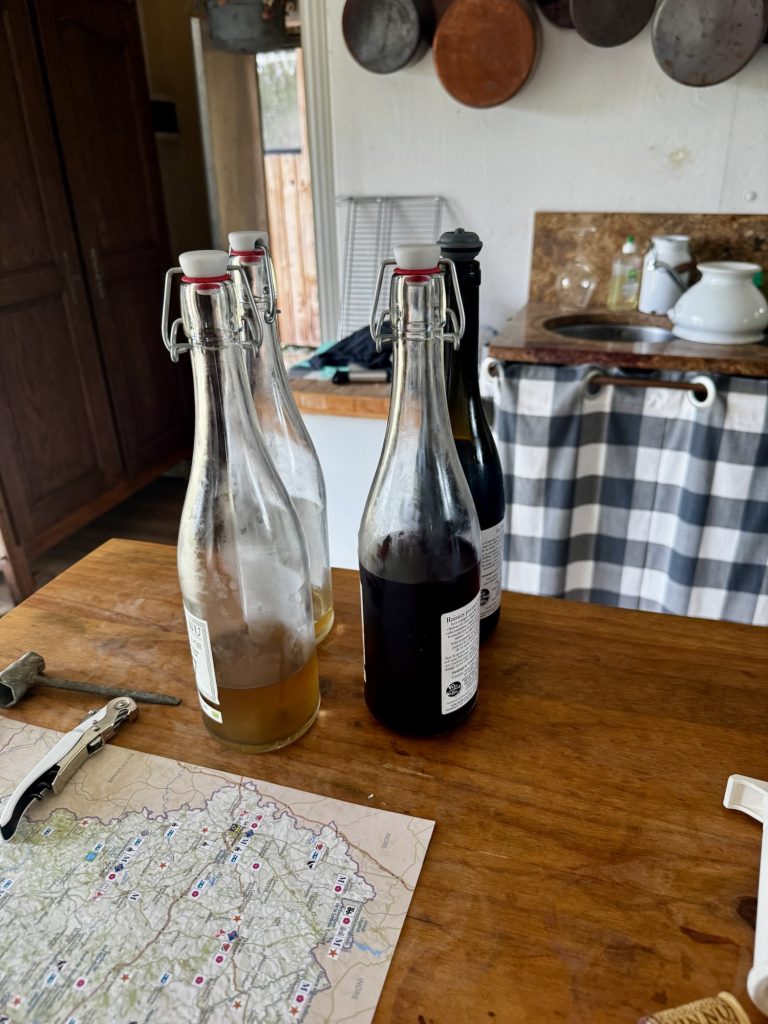
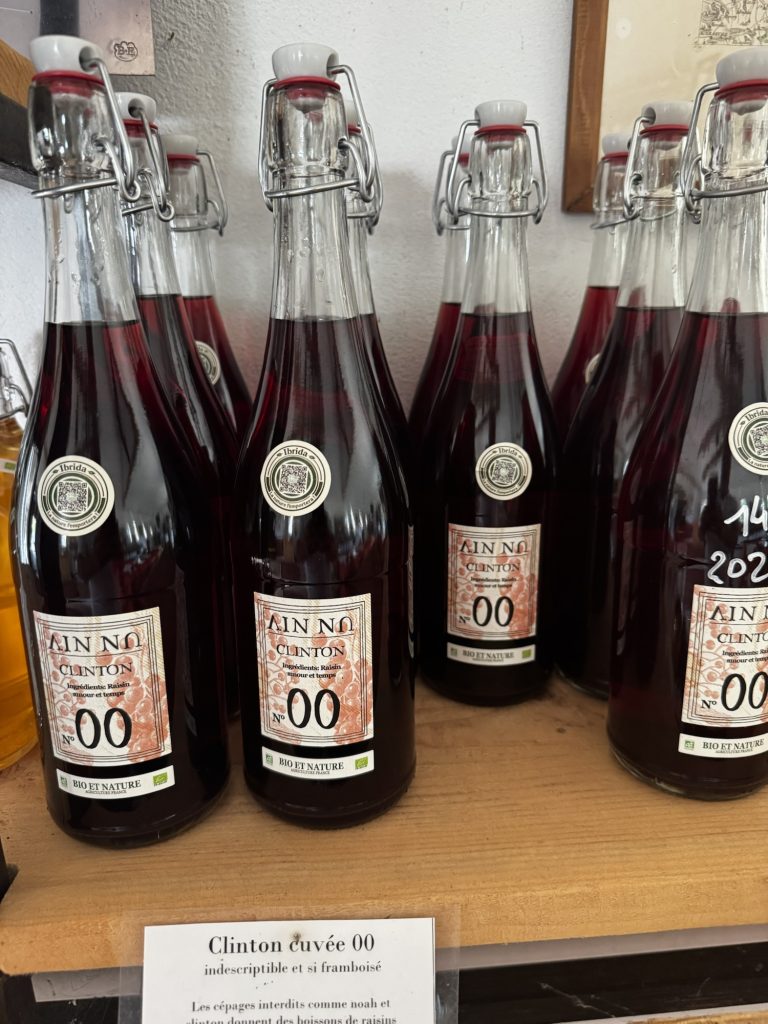
The bottle marked Clinton No. 00 stood apart.
It was in a clear swing-top bottle, filled with deep red liquid. The label named the grape plainly.
There was no longer any attempt to hide it.
Clinton had gone public.
The tasting begins
We gathered around the wooden table.
Old copper pans hung from the wall behind Geoffrey. A ceramic vessel sat in front of him beside glasses, bottle stoppers and one of the dark red wines.
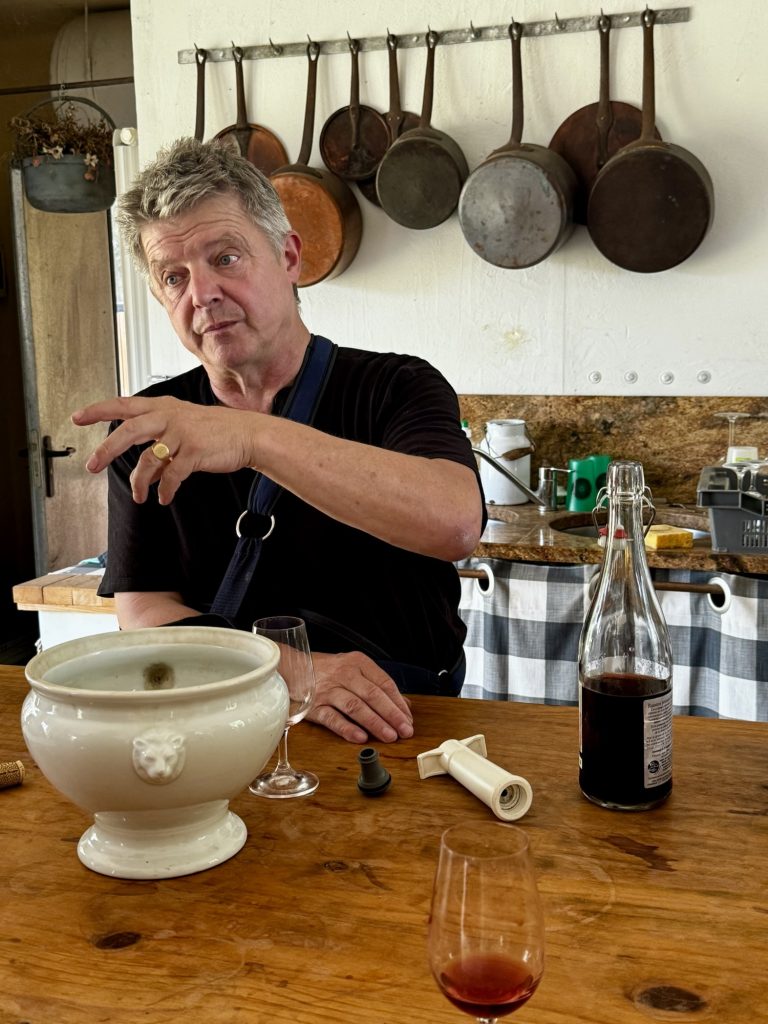
Geoffrey did not conduct the tasting like a rehearsed sales presentation.
He talked.
He explained.
He wandered into history, science, politics and personal experiments. Every bottle led somewhere else.
A white wine contained Souvignier Gris and a small proportion of Muscaris.
Only about eight per cent Muscaris was used because it was intensely aromatic.
“More would be too much,” he said.
The wine smelled floral, with a perfume that reminded Geoffrey of old roses.
Another bottle was made from Léon Millot, a dark-skinned resistant variety.
There was a pale red made through direct pressing. Red grapes were picked in the morning and pressed the same evening, limiting the time the juice spent in contact with the skins.
A more conventional red spent around three weeks macerating with the skins and seeds. It was light in alcohol but carried aromas of flowers, cloves and liquorice.
Dana and I took turns smelling the glass.
“What do you get?” Geoffrey asked.
I always find this a dangerous question during wine tasting.
Other people say blackcurrant, leather, cedar and the south-facing wall of a farmhouse after rain.
I usually get wine.
This time, however, the flavours did change as the glass sat on the table.
The floral notes softened.
Spice appeared.
Then something darker and earthier.
It was unlike the clean, predictable wines sold by the thousand in supermarkets.
These had edges.
They tasted individual.
The forbidden Clinton
Eventually Geoffrey opened the Clinton.
The variety originated in the United States and had natural resistance inherited from wild American grape species. That same ancestry gave it a distinct flavour unfamiliar to many European drinkers.
Geoffrey poured a small amount.
The colour was deep and slightly cloudy.
We smelled it first.
There was dark fruit, something wild and a strange note neither Dana nor I could immediately name.
Then we tasted it.
It was not like a polished Bordeaux or a soft commercial Merlot. It had a strong personality and no apparent interest in fitting in.
It was fruity, earthy and oddly compelling.
“You can recognise this flavour in many resistant varieties,” Geoffrey explained.
I took another sip in the interests of scientific research.
The prohibited wine had not yet harmed me.
European stability remained intact.
Burčák and the danger of standing up
Dana then began describing burčák, the young partially fermented Czech wine sold for a brief period during harvest.
It is cloudy, sweet and fruity. The fermentation is still active, meaning yeast remains in the liquid and continues converting sugar into alcohol.
“It doesn’t taste very alcoholic,” Dana said. “So you drink a lot.”
She paused.
“Then you stand up.”
Geoffrey immediately understood.
The alcohol level might be only three, four or five per cent early in fermentation, but the sweetness made it deceptively easy to drink. The bottle could also continue producing carbon dioxide, which meant it needed careful handling.
Store it incorrectly and the wine carried on fermenting whether you were ready or not.
It was less a finished drink than an alcoholic work in progress.
Geoffrey compared it with young French wines and the Beaujolais Nouveau season, though he regarded much of that as marketing.
Dana was not concerned with marketing.
Her memory involved friends, wine bars in Prague and the delayed discovery that burčák had been quietly increasing its influence while they drank it.
Beer from beneath the granite
Geoffrey had drilled down about 130 metres through granite to obtain water for irrigating his young vines.
The water tasted so pure that he decided to make beer with it.
Naturally.
He experimented with different malts and hops, brewing in small quantities while watching how the flavour changed over time.
There was still yeast in the bottle, producing a gentle natural carbonation.
“The next time you come,” he said, “you can taste it.”
This was an excellent strategy for securing repeat visitors.
He had also experimented with a grass-infused vodka inspired by Polish Żubrówka and an aquavit flavoured with herbs and spices such as fennel, cumin and anise.
Each project led to another.
The vineyard was not just a farm.
It was an ongoing list of questions.
What happens if we plant this?
What happens if we ferment that?
What happens if we use this water?
What happens if European legislation says no?
That final question seemed to be Geoffrey’s favourite.
Choosing what to take home
At the end of the visit, we stood in front of the shelves trying to decide which bottles to buy.
This was not easy.
There were dozens of numbered labels, varieties we had only just learned to pronounce and several products that technically were not wine despite looking, smelling and behaving very much like wine.
Dana considered the lighter bottles.
I was inevitably drawn to the ones most likely to upset a committee.
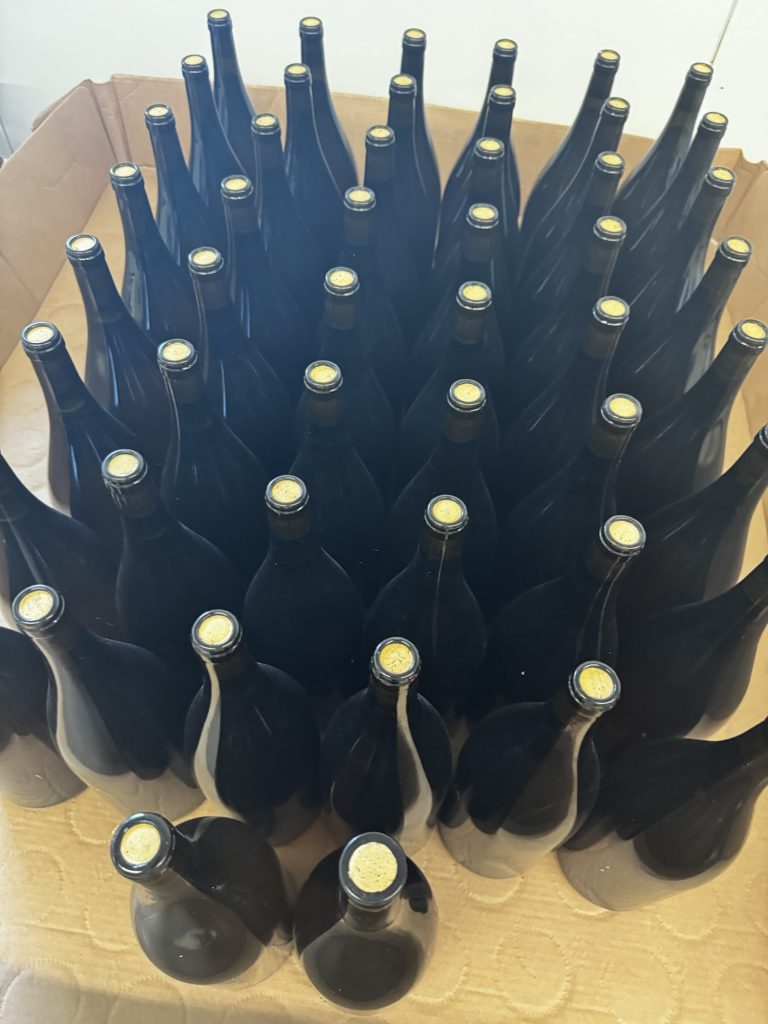
In the end, Geoffrey packed three bottles into a simple cardboard carrier with windows cut into the front.
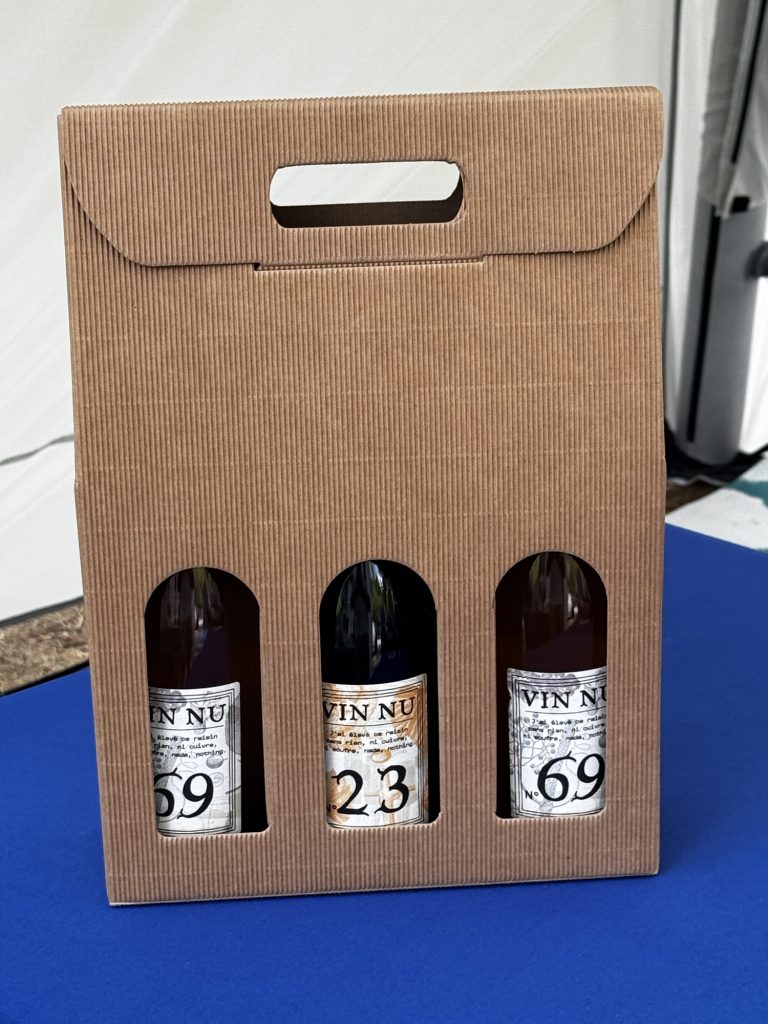
The carrier contained bottles marked 6.9, 2.3 and another 6.9, their handwritten-style labels visible through the openings.
It looked pleasingly rustic.
It also looked exactly like something that might require a lengthy explanation at customs.
More than a vineyard tour
We had expected to spend perhaps an hour walking among vines and tasting a few wines.
Instead, nearly three hours disappeared.
We talked about grapes, blueberries, Czech dumplings, soil, clover, disease, drought, climate change, yeast, bacteria, French bureaucracy, home distilling, beer, wild plums, mushrooms and the medicinal applications of spirits strong enough to restart a tractor.
The place never felt staged.
There was no polished script.
The workshop was full of real machinery. The sales room was stacked with real boxes. The vineyard showed the strain of real weather.
Geoffrey’s passion was visible in every part of it.
He had researched the grapes for years, planted them himself, trained the young vines, watched fermentation under a microscope, pressed the fruit, filled the bottles and argued for the right to call the result wine.
His injured arm had not slowed the explanation.
Nothing much seemed capable of doing that.
There was a quieter moment before we left, looking back across the rows.
The vines were still green despite the drought. The young grapes remained on their stems, waiting for rain that might not come. Geoffrey would soon have to decide whether to keep the fruit or save the plants.
That was the real story of the vineyard.
Not rebellion for its own sake.
Adaptation.
Old grapes being reconsidered because the climate had changed. Traditional rules being challenged because the land no longer behaved as expected. A farmer looking backwards through forgotten varieties to find something that might survive the future.
We placed the bottles carefully inside Bandit.
One was made from authorised grapes.
One was identified only by a number.
One had spent part of its life officially pretending not to be wine.
We drove away with all three.
European law remained unharmed, but only just.